Staying at Clarendon Square Inn, “Boston’s most scenic small hotel and the only place to stay in the heart of the hip South End area” as the Wallpaper city guide puts it. It certainly feels comfortable in this Victorian home, fully renovated with all the modern amenities (wireless, flat screen TV, etc.). (Writing now, sitting in the very inviting lounge on the first floor, fireplace, “piano à queue” and all!) We are on the top floor (if one does not mind 3 flights of stairs), room number 3, a floor away from the roof top we went to, from where one has a great panorama view of the neighborhood and beyond. This is where the hot tub is, fully operational at this cool time of the year…
Planning made easy, thanks to Nicolas Mitropolis, “Boston Greek connection extraordinaire”, Cynthia met on the last leg of a flight to Athens earlier this year…a very attentive and generous connection indeed! We practically only have to show up!
Sunny, but cool it is… And that wind – wow! We asked if it is like this all the time…we were admitted that it is today a bit more windy than usual! No kidding! And yet, there are people going around in t-shirt and shorts! It is spring, trees budding green, but we are glad we brought along warm scarves, and I regret a hat…
Enjoyed food today: lunch at Aquitaine (www.aquitaineboston.com), a bistro-style establishment in the ‘hip’ South end, a few blocks away from the B&B; part of what was an old (“the first one” according to the manager there) French hotel, the St-Cloud. Roasted Arctic Char on a bed of fresh greens and a croque-monsieur (with a light tomato bisque and fries), with a delicious white wine from the Languedoc. Very good coffee too…
Then Scampo (www.scampoboston.com), an Italian establishment on the first floor of the very touted Liberty Hotel, the former Boston jail that has been “refurbished” in a very hip hotel a few years ago, at the cost of more than $100M! Restaurant full of smart looking diners…had the baked artichoke (with sausage crumbs) for entrée – had not had artichokes for years – and shared the “Bianco” pizza (white asparagus, with dollops of mozzarella in cream, and a touch of honey). Good Pinot Noir from the Veneto.
Walked back to the B&B from dinner, a good half hour from Beacon Hill to South End. Quite invigorating in this cold wind. Had walked to the restaurant, going straight up Dartmouth Street to the river (Charles) looking for a place for jogging (there is a path along the river).
Thursday, April 21, 2011
vendredi 22 avril 2011
lundi 18 avril 2011
Less than a week in East Asia – Taipei & Hong-Kong
Back in Asia, a quick business visit, Taipei, and then, almost unexpectedly, Hong-Kong.
Never enticed by Taipei, over several visits in the last 25 years. This time though, I find the city clean, less polluted, and certainly less encumbered by traffic – it’s almost Singapore! It seems to me that it is due to the fact that much of the construction that was going on in previous visits has abated – the subway is certainly completed!
Staying at the Sheraton Taipei, chosen by our hosts. Usual good large hotel chain standards. Had stayed before at the Hyatt, closer as I recall to the Trade Center and now the new city landmark – Taipei 101 – a structure of 101 floors, reminiscent of an ancient pagoda. Remember also once staying at the Sherwood hotel – very comfortable.
Took a couple of hours to spend at the National Palace Museum. Probably the largest repository of Chinese artefacts in the world. Built in the 60’s to lodge what the Nationalists had managed to ship outside of the mainland in 1949, probably starting not long after the war was over. The collection from the Forbidden City actually had been “on the road” already for a good 15 years, having been packed away first to avoid the avatars of the civil war and of the Japanese invasion. A long itinerary starting in Beijing, then Shanghai, Nanjing, scattered somewhere further west in Sichuan, Chungqing, reassembled back east in Nanjing, to eventually finds its way to Taiwan. Fascinating collection – by far the most extensive I have ever seen. I go back every time I come to Taipei. Such a trove to discover.
Had lunch at the Silks Palace on the ground of the Museum, not knowing that our hosts was going to take us there for dinner the day after…
Invited a few colleagues for dinner at the Grand Hotel, built in the early 50’s, in the pure grandiose traditional Chinese – majestic lobby, lots of reds and marble. A sight to see; the restaurant, the Golden Dragon, is overseeing the Danshui River, nearby. The food of course is rather mediocre (and the wine selection awfully limited!) Would have dined better at the Din Tai Fung on xiaolungbao! Well, I knew I was not coming for the food…
Flew to Hong-Kong for more meetings. On Cathay Pacific – always a pleasure to fly on their wings, even if it is a short flight. Staying at a new place, a boutique hotel in Wanchai – The Fleming. Brand new, roomy quarters, rather slick. Would stay again…amidst the “humanity” of Wanchai – such dense crowd. Gentrifying at the west end of the area, off the Admiralty –new high rises, bars and restaurants. Had a glass of wine in the area with Ted.
Remarkable dinner at the 8 1/2 Otto y mezzo restaurant (apparently would have just got its second Michelin Star), at the invitation of Bernard, an old French Canadian friend, there since the late 70’s when I came first in hong-Kong to live(there is a story here!) Joined a party of some 25 of their friends and business contacts to sample the food of “chef invité” Normand Laprise, from the very hip and fashionable Montréal restaurant “Toqué!”, well wine-paired by the local sommelier. Long conversation with chef Laprise…
Coincidence, dinner with old British friends (second tour of duty - mid 90’s - vintage!) at the same venue as we had the last time, a few years back, the LRC (Ladies Recreational Center), on Old Peak Road, across from where I lived some 30 years ago! For the same reason: a wine degustation, from Lebanon this time – Chateau Musar - with the patriarch, Serge, in attendance!
Never enticed by Taipei, over several visits in the last 25 years. This time though, I find the city clean, less polluted, and certainly less encumbered by traffic – it’s almost Singapore! It seems to me that it is due to the fact that much of the construction that was going on in previous visits has abated – the subway is certainly completed!
Staying at the Sheraton Taipei, chosen by our hosts. Usual good large hotel chain standards. Had stayed before at the Hyatt, closer as I recall to the Trade Center and now the new city landmark – Taipei 101 – a structure of 101 floors, reminiscent of an ancient pagoda. Remember also once staying at the Sherwood hotel – very comfortable.
Took a couple of hours to spend at the National Palace Museum. Probably the largest repository of Chinese artefacts in the world. Built in the 60’s to lodge what the Nationalists had managed to ship outside of the mainland in 1949, probably starting not long after the war was over. The collection from the Forbidden City actually had been “on the road” already for a good 15 years, having been packed away first to avoid the avatars of the civil war and of the Japanese invasion. A long itinerary starting in Beijing, then Shanghai, Nanjing, scattered somewhere further west in Sichuan, Chungqing, reassembled back east in Nanjing, to eventually finds its way to Taiwan. Fascinating collection – by far the most extensive I have ever seen. I go back every time I come to Taipei. Such a trove to discover.
Had lunch at the Silks Palace on the ground of the Museum, not knowing that our hosts was going to take us there for dinner the day after…
Invited a few colleagues for dinner at the Grand Hotel, built in the early 50’s, in the pure grandiose traditional Chinese – majestic lobby, lots of reds and marble. A sight to see; the restaurant, the Golden Dragon, is overseeing the Danshui River, nearby. The food of course is rather mediocre (and the wine selection awfully limited!) Would have dined better at the Din Tai Fung on xiaolungbao! Well, I knew I was not coming for the food…
The Grand Hotel, a Taipei landmark, is built on a hilltop in traditional Chinese palace architecture. With the largest Chinese classical style roof in the world, vermilion pillars, stately archways, and brilliant roof tiles, it is quite spectacular. First built in 1952, it underwent many additions and expansions until its completion in 1973. After a disastrous fire in 1995, the hotel was repaired, and reopened to the public in 1998.
SOURCE: Xiao-Si Huang, courtesy of Tourism Bureau, Ministry of Transportation & Communications , R.O.C.

Above picture of Grand Hotel lobby, taken by Taiwan Junior, reproduced here under a CC license.SOURCE: Xiao-Si Huang, courtesy of Tourism Bureau, Ministry of Transportation & Communications , R.O.C.

Flew to Hong-Kong for more meetings. On Cathay Pacific – always a pleasure to fly on their wings, even if it is a short flight. Staying at a new place, a boutique hotel in Wanchai – The Fleming. Brand new, roomy quarters, rather slick. Would stay again…amidst the “humanity” of Wanchai – such dense crowd. Gentrifying at the west end of the area, off the Admiralty –new high rises, bars and restaurants. Had a glass of wine in the area with Ted.
Remarkable dinner at the 8 1/2 Otto y mezzo restaurant (apparently would have just got its second Michelin Star), at the invitation of Bernard, an old French Canadian friend, there since the late 70’s when I came first in hong-Kong to live(there is a story here!) Joined a party of some 25 of their friends and business contacts to sample the food of “chef invité” Normand Laprise, from the very hip and fashionable Montréal restaurant “Toqué!”, well wine-paired by the local sommelier. Long conversation with chef Laprise…
Coincidence, dinner with old British friends (second tour of duty - mid 90’s - vintage!) at the same venue as we had the last time, a few years back, the LRC (Ladies Recreational Center), on Old Peak Road, across from where I lived some 30 years ago! For the same reason: a wine degustation, from Lebanon this time – Chateau Musar - with the patriarch, Serge, in attendance!
dimanche 6 mars 2011
Pembroke, Ontario
March 5
Unusual destination – Pembroke! Because Cynthia’s parents live there. Drove all the way from Toronto, via what I would call the “northern” route (because it does not go all the way through the 401, then the 416 to Ottawa, then the trans-Canadian to destination!) Rained until it started snowing about ¾ of the way. 400km in 4 hours and a half.
A bit of a discovery. The B&B, Grey Gables Manor, (which Cynthia booked well in advance, i.e. this morning before we left – such a planner!!!) is actually a century old (this is their centennial year – the place was built in 1911) house in the style of Tudor (or “stock-broker Tudor” as they referred to it at the time!) built by a wealthy (must have been!) lumber baron, E.A. Dunlop (he was also the President of the Centenary Committee back in 1928). It is a beautiful manor, with a grand hallway, leaded-glass windows and an “impressive carved staircase”, as the B&B website (http://www.greygablesmanor.com/index.html) puts it. I am intrigued by the pressed tin ceilings that are found throughout the place – did the tin act as an insulator, soundproofing, as fire- retardant material, or simply as a decorative element? In any case, the B&B has been well renovated, with modern amenities in bathroom (and wireless access to the net – a sine qua non feature, for me anyway!) We stayed in the Library room, on the same floor as the hallway – great setting with a “live” fireplace and lots of space.
Actually Pembroke has quite a history, going back all the way to Champlain who would have visited in 1613 the site that was to become Pembroke, along the Ottawa River, about 100 miles upstream from the capital. Settlers came much later on in the early 19th century – there is a book in our B&B library room celebrating the place’s centennial, dated 1928! The first white settler, a fellow by the name of Daniel Fraser, would have come in 1823, followed by Peter White, a veteran of the Royal Navy, in 1828. Lumbering was the attraction, and apparently fortunes were made, cutting wood and floating it to saw mills down the Ottawa River. Pembroke is situated at the confluent of a lesser river, the Muskrat, with the Ottawa River. Those are by-gone years though as I don’t think there is any wood left to cut, and if there were, it would certainly not be allowed to float down the river! Other industries and farming eventually took over – I seem to recall coming here some 35 years ago to visit a Northern Electric (eventually known as Nortel, now defunct –sad story, but another story!) facility, as a young diplomat learning what Canada has to offer to the world! No doubt gone by now, probably even before the demise of Nortel…
Pembroke, named after one of the Earls of Pembroke in the mid 19th century, has today a population of some 15,000 to 20,000 people, all surroundings considered. It’s the most important city between Ottawa and North Bay, further north. It is near the Petawawa military base, and the AECL Chalk River reactor is also nearby – the world’s largest source of medical isotopes used to diagnose and treat many life threatening diseases…it became an issue when the reactor shut down a year or so ago... It’s also considered as the gateway to internationally famous Algonquin Park (http://www.algonquinpark.on.ca/), and to world-class whitewater rafting, a little bit on the southwest. More on Pembroke: (http://www.pembrokeontario.com/residents/-cultural-heritage/)
Pembroke, March 6, 2011
The snow has stopped this morning, leaving a good 6 or 7 inches of fresh fluffy stuff...
samedi 26 février 2011
Greece – Athens …et l’Acropole
Athens: One is struck by how spread out the city is. Like a carpet of low-rise buildings that extends to surrounding hills. At least 3.5 Million people – more according to other sources – in a country of just 11 Million people. Politically and economically in trouble. Could not service its debt. IMF, ECB and EC (the”troika” as it is referred to here!) agreed to lend some 100M Euros, in return for the Papandreou Government imposing a very stringent austerity public finance program, which is leading people to strike (well-planned, staggered ones!) and demonstrate (we were witnesses to one demonstration – cocktail Molotov, tear gas and all!) Still in deepening recession, with an official unemployment rate of close to 14%...
Fifty years ago - first intorduction to Greece, thanks to a series I (or my sister or brother, for me)had subscribed to, called Programme "tour du monde", published with the collaboration de l'Association française de Géographie - I loved that series...I still have all those "livrets", 30 or 40 of them in our librairy...
Not great weather – did not expect one either, but cooler than what is experienced usually at this time of the year (went down from a high 15 degrees to a wet and low 8 degrees by the time we left!)
We are coming in from the Peloponnese. Stopped at the canal on the isthmus of Corinth on our way: a dozen years in digging – open in 1893 – allowing ships coming from the North to avoid having to go all the way around the whole of Peloponnese to get to Athens or further east on the Mediterranean Sea, something that had eluded all previous efforts to dig, including those of Alexander the Great. Accomodate more than 10,000 ships a year. According to the commemorative information on site, it would have been built with Hungarian participation – although other sources refer to the French company, Société Internationale du Canal Maritime de Corinthe, as the main provider of the required “explosive” technology. Impressive to the point of giving you vertigo, very narrow, no more than 25 meters wide, but some 80 meters straight down from the rims; about 6km long.
Evidemment, l’Acropole! Déjà une vue exceptionnelle de l’hôtel (Intercontinental). L’avantage d’y être à ce moment-ci de l’année, c’est qu’il y a peu de touristes, mais tout de même, nous ne sommes pas seuls (nous rencontrons un couple cypriote, vivant à Londres et voyageant avec leur petite fille, Pellas, avec qui nous sympathisons, entre autres sur la situation politique à Chypre bien sûr). Le Parthénon, même en ruines (entre autre partiellement détruit par une explosion de la poudrière qu’y avaient logé les Turcs, cible des canons des envahisseurs vénitiens en 1687), impressionne. Dans son intégrité – comme on le verra dans une maquette au nouveau Musée – c’est un bâtiment aux proportions et aux lignes parfaites, inspiration intarissable de l’architecture de toute une civilisation (la nôtre) depuis son édification au « Siècle de Périclès » 2500 ans passés! Doit-on le restaurer? C’est ce à quoi s’emploie le gouvernement grec depuis 1983, avec l’appui de la Communauté Européenne depuis. Je n’en suis pas convaincu : des ruines, c’est des ruines! Consolation cependant : à la vitesse oàu les travaux progressent, le Parthénon risque d’être une «ruine » pendant longtemps!
On retrouve évidemment d’autre monuments : l’Acropole, c’est un aménagement complet, bâti et modifié sur des siècles – on aime bien l’Erechthéion, avec ses 6 Cariatydes (des répliques, sauf pour une je présume; 4 des originales sont maintenant au nouveau musée (quant à la 6e, elle se trouve au British Museum!), pour mieux les conserver et les protéger des effets néfastes considérables de la pollution industrielle (elles sont entrain d’ailleurs de se faire « nettoyer » au laser).
L’Agora, tout juste au bas de l’Acropole, est chargée d’histoire. Les évocations sont nombreuses : le berceau de la « démocratie », l’endroit de prédilection des philosophes qui nous inspirent encore – Socrate, qui devait être suivi de Platon et d’Aristote plus tard, et oàu se sont joués, dans l’Odéon, les grands dramaturges classiques – Eschyle, Euripide, Sophocle, et d’autres.
C’est la place publique oàu on ne fait pas que discuter, mais oàu on y achète, car c’est aussi un marché, avec ses étoles de marchands de tout acabit. Aujourd’hui plutôt un site archéologique : que des ruines dont on ne retrouve la trace que par les fondations sur le sol; sauf pour le temple d'Héphaïstos ou Théséion, structure dorique remarquablement conservé,et le portique ou « stoa » de l’Attale, immense bâtiment construit sur la longueur et à deux étages, érigé au 2e siècle avant JC comme un espèce de « mall » moderne, abritant de petits magasins, et totalement rénové dans les années 50 par les Américains (grâce à l’argent de J.D. Rockefeller!) qui loge aujourd’hui le musée de l’Agora.
Ce qui frappe cependant, c’est le fait que tout çà n’est pas statique : l’Agora a existé sur des siècles et a considérablement changé de vocation tout au cours, centrale à l’existence publique et commerciale de la ville-état à plusieurs reprises, et parfois, en d’autres temps, presque délaissée, à l’abandon… Par exemple durant les époques romaines ou byzantines d’Athènes, elle servit comme lieu résidentiel (ce qui était encore le cas plus récemment, alors que pour fouiller le site entier à partir des années 30, il a fallu démolir plus de 360 maisons modernes !)
Je n’ai guère le temps de visiter quoique ce soit d’autre – c’est Cynthia qui me rapportera ses commentaires, après avoir visité par exemple les ruines du temple de Zeus Olympien ou encore le Musée national d’archéologie… J’ai quand même l’occasion d’admirer le Stade Kallimarmaro (que l’on appelle aussi plus officiellement le Stade Panathinaiko) devant lequel je passe tout les jours en route pour l’hôtel oàu se tiennent les rencontres; fait entièrement de marbre, bâti pour les premiers Jeux Olympiques modernes de 1896 (pouvant accommoder plus de 80,000 personnes; aujourd’hui, quelque 45,000 spectateurs – on l’utilise en grande partie pour des concerts; l’acoustique y est apparemment remarquable!), sur les bases du stade construit au 4e siècle avant JC. Si j’ai bien compris, il était alors utilisé pour la tenue régulière des jeux dits « Panathénaiques » (les Jeux Olympiques de l’antiquité étaient tenus à Olympe, dans le Péloponnèse, de 776 avant JC à 393 après JC). C’est dans son enceinte que le premier marathon des jeux modernes s’est terminé – avec la victoire d’un Grec, Spiridon Louis, comme il se devait! Rappelons-le, le marathon fait 26 milles et 385 verges, la distance entre le port de Marathon et le stade!Il commémore la fameuse course du soldat grec Pheidippides, pour porter aux Athéniens le message de la victoire de la Bataille de Marathon sur les perses en 490 av. J.-C. ("nous avons gagné" - il serait mort exténué apparamment imméditatement après avoir livrer son message!) C’est ailleurs que se sont tenus cependant les jeux de 2004, quoique c’est là encore une fois que s’est terminé le marathon, gagné cette fois par un « non-Grec » (un italien, je crois)!
Une visite s’impose cependant au nouveau musée de l’Acropole (un des principaux musées de la Grèce, il abrite les objets provenant des monuments et des fouilles sur l’Acropole) ; construit selon les plans de l’architecte Bernard Tchumi (ancien recteur de l’école d’architecture de l’université Columbia à New-York et patron de la boîte oàu Laurence, à la demande de Tchumi même, a fait un stage!)Inauguré il n’y a que quelques années (2009 – il faut lire par ailleurs la « petite » histoire mouvementée qui entoure sa construction et les controverses qu’elle a soulevées, entre autres autour des fameux « marbres d’Elgin », toujours logés au British Museum à Londres et pour lesquels on a « fait de la place » au nouveau musée en marquant leurs positions sur la frise du Parthénon exposée par des moulages! Voir sur Wikipédia.)
Went to see the première of Béjart’s “Ballet for Life” in Athens (for 4 days) – this 1997 ballet, which debuted in Paris, built on a mix of Queen’s and Mozart’s music. Dedicated to Freddie Mercury, the lead singer and “heart & soul” of Queen (great clips of his performance as a dancer that must have inspired the now defunct Béjart), and to leading Béjart’s company dancer, Jorge Donn; both Mercury and Donn died at the same early age of 45, amongst the first victims of AIDS. Costumes are from Versace, likely his last work before he himself died, shot in Miami the same year the production came out. If you have to go by the program, the production has been around the world, in almost all major cities (including Montreal but not Toronto!). Took place in the Badminton Theater – its name is understood once you learn that it was a former 2004 Olympics’ facility, turned into a very popular performance location a few years back.
Fascinating performance! A “ballet of youth and hope” as Béjart himself described it! Certainly different from Béjart’s ballet pieces I have seen in the past. It’s a Rock ‘n Roll work. Queen, a discovery for me – not for Cynthia though who was “brought up” on their music… (See www.bejart.ch)
Restaurants: Went to well-publicized ones (Plous Podilatou in the Piraeus; Daphne’s; ManiMani; Psara’s) but discovered one on our own, Strofi, a recently upgraded “taverna”, great food, with a fantastic view of the Acropolis and the Parthenon (second floor, window table – owner/operator Niko).Enjoyed Greek food, moussaka, souvlaki and all (delicious feta cheese when deep-fried – served with warm honey and sesame at Strofi), and great local white and red wines (Greece, as one would expect,has had an ever lasting "love affair" with wine - see http://www.greekwinemakers.com/index.html).
Athens, February 25, 2011
Fifty years ago - first intorduction to Greece, thanks to a series I (or my sister or brother, for me)had subscribed to, called Programme "tour du monde", published with the collaboration de l'Association française de Géographie - I loved that series...I still have all those "livrets", 30 or 40 of them in our librairy...
Not great weather – did not expect one either, but cooler than what is experienced usually at this time of the year (went down from a high 15 degrees to a wet and low 8 degrees by the time we left!)
We are coming in from the Peloponnese. Stopped at the canal on the isthmus of Corinth on our way: a dozen years in digging – open in 1893 – allowing ships coming from the North to avoid having to go all the way around the whole of Peloponnese to get to Athens or further east on the Mediterranean Sea, something that had eluded all previous efforts to dig, including those of Alexander the Great. Accomodate more than 10,000 ships a year. According to the commemorative information on site, it would have been built with Hungarian participation – although other sources refer to the French company, Société Internationale du Canal Maritime de Corinthe, as the main provider of the required “explosive” technology. Impressive to the point of giving you vertigo, very narrow, no more than 25 meters wide, but some 80 meters straight down from the rims; about 6km long.
Evidemment, l’Acropole! Déjà une vue exceptionnelle de l’hôtel (Intercontinental). L’avantage d’y être à ce moment-ci de l’année, c’est qu’il y a peu de touristes, mais tout de même, nous ne sommes pas seuls (nous rencontrons un couple cypriote, vivant à Londres et voyageant avec leur petite fille, Pellas, avec qui nous sympathisons, entre autres sur la situation politique à Chypre bien sûr). Le Parthénon, même en ruines (entre autre partiellement détruit par une explosion de la poudrière qu’y avaient logé les Turcs, cible des canons des envahisseurs vénitiens en 1687), impressionne. Dans son intégrité – comme on le verra dans une maquette au nouveau Musée – c’est un bâtiment aux proportions et aux lignes parfaites, inspiration intarissable de l’architecture de toute une civilisation (la nôtre) depuis son édification au « Siècle de Périclès » 2500 ans passés! Doit-on le restaurer? C’est ce à quoi s’emploie le gouvernement grec depuis 1983, avec l’appui de la Communauté Européenne depuis. Je n’en suis pas convaincu : des ruines, c’est des ruines! Consolation cependant : à la vitesse oàu les travaux progressent, le Parthénon risque d’être une «ruine » pendant longtemps!
On retrouve évidemment d’autre monuments : l’Acropole, c’est un aménagement complet, bâti et modifié sur des siècles – on aime bien l’Erechthéion, avec ses 6 Cariatydes (des répliques, sauf pour une je présume; 4 des originales sont maintenant au nouveau musée (quant à la 6e, elle se trouve au British Museum!), pour mieux les conserver et les protéger des effets néfastes considérables de la pollution industrielle (elles sont entrain d’ailleurs de se faire « nettoyer » au laser).
L’Agora, tout juste au bas de l’Acropole, est chargée d’histoire. Les évocations sont nombreuses : le berceau de la « démocratie », l’endroit de prédilection des philosophes qui nous inspirent encore – Socrate, qui devait être suivi de Platon et d’Aristote plus tard, et oàu se sont joués, dans l’Odéon, les grands dramaturges classiques – Eschyle, Euripide, Sophocle, et d’autres.
C’est la place publique oàu on ne fait pas que discuter, mais oàu on y achète, car c’est aussi un marché, avec ses étoles de marchands de tout acabit. Aujourd’hui plutôt un site archéologique : que des ruines dont on ne retrouve la trace que par les fondations sur le sol; sauf pour le temple d'Héphaïstos ou Théséion, structure dorique remarquablement conservé,et le portique ou « stoa » de l’Attale, immense bâtiment construit sur la longueur et à deux étages, érigé au 2e siècle avant JC comme un espèce de « mall » moderne, abritant de petits magasins, et totalement rénové dans les années 50 par les Américains (grâce à l’argent de J.D. Rockefeller!) qui loge aujourd’hui le musée de l’Agora.
Ce qui frappe cependant, c’est le fait que tout çà n’est pas statique : l’Agora a existé sur des siècles et a considérablement changé de vocation tout au cours, centrale à l’existence publique et commerciale de la ville-état à plusieurs reprises, et parfois, en d’autres temps, presque délaissée, à l’abandon… Par exemple durant les époques romaines ou byzantines d’Athènes, elle servit comme lieu résidentiel (ce qui était encore le cas plus récemment, alors que pour fouiller le site entier à partir des années 30, il a fallu démolir plus de 360 maisons modernes !)
Je n’ai guère le temps de visiter quoique ce soit d’autre – c’est Cynthia qui me rapportera ses commentaires, après avoir visité par exemple les ruines du temple de Zeus Olympien ou encore le Musée national d’archéologie… J’ai quand même l’occasion d’admirer le Stade Kallimarmaro (que l’on appelle aussi plus officiellement le Stade Panathinaiko) devant lequel je passe tout les jours en route pour l’hôtel oàu se tiennent les rencontres; fait entièrement de marbre, bâti pour les premiers Jeux Olympiques modernes de 1896 (pouvant accommoder plus de 80,000 personnes; aujourd’hui, quelque 45,000 spectateurs – on l’utilise en grande partie pour des concerts; l’acoustique y est apparemment remarquable!), sur les bases du stade construit au 4e siècle avant JC. Si j’ai bien compris, il était alors utilisé pour la tenue régulière des jeux dits « Panathénaiques » (les Jeux Olympiques de l’antiquité étaient tenus à Olympe, dans le Péloponnèse, de 776 avant JC à 393 après JC). C’est dans son enceinte que le premier marathon des jeux modernes s’est terminé – avec la victoire d’un Grec, Spiridon Louis, comme il se devait! Rappelons-le, le marathon fait 26 milles et 385 verges, la distance entre le port de Marathon et le stade!Il commémore la fameuse course du soldat grec Pheidippides, pour porter aux Athéniens le message de la victoire de la Bataille de Marathon sur les perses en 490 av. J.-C. ("nous avons gagné" - il serait mort exténué apparamment imméditatement après avoir livrer son message!) C’est ailleurs que se sont tenus cependant les jeux de 2004, quoique c’est là encore une fois que s’est terminé le marathon, gagné cette fois par un « non-Grec » (un italien, je crois)!
Une visite s’impose cependant au nouveau musée de l’Acropole (un des principaux musées de la Grèce, il abrite les objets provenant des monuments et des fouilles sur l’Acropole) ; construit selon les plans de l’architecte Bernard Tchumi (ancien recteur de l’école d’architecture de l’université Columbia à New-York et patron de la boîte oàu Laurence, à la demande de Tchumi même, a fait un stage!)Inauguré il n’y a que quelques années (2009 – il faut lire par ailleurs la « petite » histoire mouvementée qui entoure sa construction et les controverses qu’elle a soulevées, entre autres autour des fameux « marbres d’Elgin », toujours logés au British Museum à Londres et pour lesquels on a « fait de la place » au nouveau musée en marquant leurs positions sur la frise du Parthénon exposée par des moulages! Voir sur Wikipédia.)
Went to see the première of Béjart’s “Ballet for Life” in Athens (for 4 days) – this 1997 ballet, which debuted in Paris, built on a mix of Queen’s and Mozart’s music. Dedicated to Freddie Mercury, the lead singer and “heart & soul” of Queen (great clips of his performance as a dancer that must have inspired the now defunct Béjart), and to leading Béjart’s company dancer, Jorge Donn; both Mercury and Donn died at the same early age of 45, amongst the first victims of AIDS. Costumes are from Versace, likely his last work before he himself died, shot in Miami the same year the production came out. If you have to go by the program, the production has been around the world, in almost all major cities (including Montreal but not Toronto!). Took place in the Badminton Theater – its name is understood once you learn that it was a former 2004 Olympics’ facility, turned into a very popular performance location a few years back.
Fascinating performance! A “ballet of youth and hope” as Béjart himself described it! Certainly different from Béjart’s ballet pieces I have seen in the past. It’s a Rock ‘n Roll work. Queen, a discovery for me – not for Cynthia though who was “brought up” on their music… (See www.bejart.ch)
Restaurants: Went to well-publicized ones (Plous Podilatou in the Piraeus; Daphne’s; ManiMani; Psara’s) but discovered one on our own, Strofi, a recently upgraded “taverna”, great food, with a fantastic view of the Acropolis and the Parthenon (second floor, window table – owner/operator Niko).Enjoyed Greek food, moussaka, souvlaki and all (delicious feta cheese when deep-fried – served with warm honey and sesame at Strofi), and great local white and red wines (Greece, as one would expect,has had an ever lasting "love affair" with wine - see http://www.greekwinemakers.com/index.html).
Athens, February 25, 2011
lundi 21 février 2011
Grèce – Théâtre d’Epidaure & Mycènes
Réveil matinal, comme à l’habitude; déjeuner copieux à l’hôtel et promenade dans la ville (pour digérer un peu, le temps d’un cigarillo!) Départ en voiture début de matinée pour ce qu’on nous a décrit comme théâtre grec ancien le plus impressionnant et le mieux conservé de toute la Grèce, situé à Épidaure (Epidavros), à une trentaine de kilomètres à l’est de Nafplio. Effectivement impressionnant; supérieur à bien des égards à celui qui pourtant nous avait laissé marqués à Syracuse, en Sicile en décembre dernier!
Construit au milieu du 4e siècle avant J-C, son auditorium est presqu’intact, pouvant assoir dit-on, si l’on compte la douzaine de rangées supérieures ajoutées quelques siècles plus tard, plus de 15,000 spectateurs. On l’utilise encore l’été pour des représentations de pièces du répertoire grec classique entre autres (à voir, un jour…) Cynthia et moi sommes seuls – incroyable et inespéré! Les cars de touristes arriveront plus tard. Du centre de l’orchestre, la voix porte admirablement bien jusqu’aux derniers gradins – acoustique remarquable. On s’amuse, Cynthia à dédier sa visite aux acteurs du Stratford Shakespeare Festival qui ont quitté la scène (de la vie!) cette année; moi, à déclamer quelques lignes du Cid de Corneille dont je me rappelle encore ("O rage,o désespoir...")!
Le théâtre fait partie d’un grand ensemble architectural dédié aux soins médicaux – le Sanctuaire d’Asclepios, dieu de la Santé – dont il ne reste plus que les fondations, auxquels s’acharnent des archéologues payés par l’UNESCO à reconstruire – un véritable casse-tête et un travail de moine!
On se rend tout de même au Stade du Sanctuaire, toujours dans le même ensemble, dont la piste de course, qui fait plus de 180 mètres de long sur une vingtaine, reste intacte, bordée de chaque côté par des gradins situés à peu près à mi-parcours. Le stade devait supposément accommoder plus de 6000 spectateurs. J’ai l’impression qu’il manque beaucoup de gradins, qu’on s’affaire d’ailleurs, ici comme ailleurs sur le campus, à reconstituer. Reste aussi des stèles d’un mètre ou plus, tout au long d'une dalle de pierre au sol, qui marquent la ligne de départ et séparent les coureurs des uns des autres. On peu presque imaginer les coureurs, nus évidemment, en position de départ (debout à l’époque, légèrement inclinés, paraît-il…) On y tenait des compétitions à tous les 4 ans qui devaient faire partie du calendrier pan hellénique des jeux, incluant ceux d’Olympe.
Filons sur Mycènes, sur la route de retour vers Athènes. Site archéologique incroyable, encore exploré de nos jours, travaux d’excavation déjà commencés par les français d’abord (expédition de 1822) puis beaucoup plus à fond par l’allemand Heinrich Schliemann (1876). Ses ruines avaient même été visitées par un chroniqueur grec au 2e siècle apr. J.-C. On peut se demander d’ailleurs si à l’époque on avait le même engouement pour les vestiges du passé – au moins 10 siècles séparent l’apogée de Mycènes et l’époque classique grecque du 5e siècle av. J.-C. – que nous en avons maintenant à l’égard d’un passé même un peu plus récent…probablement pas !
Mycènes, ville presque mythique qui remonte au 17e siècle avant J.-C. et qu’Homère cite dans l’Iliade comme la ville d’Agamemnon qui mena les troupes grecques dans le siège de Troie. Ville qui donna son nom à la civilisation mycénienne de la Grèce préhistorique. Les ruines datent probablement du 14e siècle avant J.-C., au moment oàu Mycènes acquière ses premières fortifications et prospère pendant les 2 siècles qui suivent. Ville riche en or – plusieurs vestiges en métal précieux, dont cet extraordinaire masque, faussement appelé « Masque d’Agamemnon », qui remonte au milieu du 16e siècle avant J.-C., sont conservés au Musée national d’archéologie à Athènes (copies au musée local)
Sa ruine et sa décadence sont mal expliquées : causes naturelles (tremblements de terre?) ou crises de civilisation, il semble qu’on ne le sait pas… A tout évènement, Mycènes, dès le 12e siècle av. J -C., devait graduellement disparaître dans la nuit des temps…
D’autres sites environnants mériteraient une visite, Argos ou encore Nemae, mais le temps nous manque et on nous attend pour dîner à Athènes…
Athènes, dimanche le 20 février 2011
Construit au milieu du 4e siècle avant J-C, son auditorium est presqu’intact, pouvant assoir dit-on, si l’on compte la douzaine de rangées supérieures ajoutées quelques siècles plus tard, plus de 15,000 spectateurs. On l’utilise encore l’été pour des représentations de pièces du répertoire grec classique entre autres (à voir, un jour…) Cynthia et moi sommes seuls – incroyable et inespéré! Les cars de touristes arriveront plus tard. Du centre de l’orchestre, la voix porte admirablement bien jusqu’aux derniers gradins – acoustique remarquable. On s’amuse, Cynthia à dédier sa visite aux acteurs du Stratford Shakespeare Festival qui ont quitté la scène (de la vie!) cette année; moi, à déclamer quelques lignes du Cid de Corneille dont je me rappelle encore ("O rage,o désespoir...")!
Le théâtre fait partie d’un grand ensemble architectural dédié aux soins médicaux – le Sanctuaire d’Asclepios, dieu de la Santé – dont il ne reste plus que les fondations, auxquels s’acharnent des archéologues payés par l’UNESCO à reconstruire – un véritable casse-tête et un travail de moine!
On se rend tout de même au Stade du Sanctuaire, toujours dans le même ensemble, dont la piste de course, qui fait plus de 180 mètres de long sur une vingtaine, reste intacte, bordée de chaque côté par des gradins situés à peu près à mi-parcours. Le stade devait supposément accommoder plus de 6000 spectateurs. J’ai l’impression qu’il manque beaucoup de gradins, qu’on s’affaire d’ailleurs, ici comme ailleurs sur le campus, à reconstituer. Reste aussi des stèles d’un mètre ou plus, tout au long d'une dalle de pierre au sol, qui marquent la ligne de départ et séparent les coureurs des uns des autres. On peu presque imaginer les coureurs, nus évidemment, en position de départ (debout à l’époque, légèrement inclinés, paraît-il…) On y tenait des compétitions à tous les 4 ans qui devaient faire partie du calendrier pan hellénique des jeux, incluant ceux d’Olympe.
Filons sur Mycènes, sur la route de retour vers Athènes. Site archéologique incroyable, encore exploré de nos jours, travaux d’excavation déjà commencés par les français d’abord (expédition de 1822) puis beaucoup plus à fond par l’allemand Heinrich Schliemann (1876). Ses ruines avaient même été visitées par un chroniqueur grec au 2e siècle apr. J.-C. On peut se demander d’ailleurs si à l’époque on avait le même engouement pour les vestiges du passé – au moins 10 siècles séparent l’apogée de Mycènes et l’époque classique grecque du 5e siècle av. J.-C. – que nous en avons maintenant à l’égard d’un passé même un peu plus récent…probablement pas !
Mycènes, ville presque mythique qui remonte au 17e siècle avant J.-C. et qu’Homère cite dans l’Iliade comme la ville d’Agamemnon qui mena les troupes grecques dans le siège de Troie. Ville qui donna son nom à la civilisation mycénienne de la Grèce préhistorique. Les ruines datent probablement du 14e siècle avant J.-C., au moment oàu Mycènes acquière ses premières fortifications et prospère pendant les 2 siècles qui suivent. Ville riche en or – plusieurs vestiges en métal précieux, dont cet extraordinaire masque, faussement appelé « Masque d’Agamemnon », qui remonte au milieu du 16e siècle avant J.-C., sont conservés au Musée national d’archéologie à Athènes (copies au musée local)
Sa ruine et sa décadence sont mal expliquées : causes naturelles (tremblements de terre?) ou crises de civilisation, il semble qu’on ne le sait pas… A tout évènement, Mycènes, dès le 12e siècle av. J -C., devait graduellement disparaître dans la nuit des temps…
D’autres sites environnants mériteraient une visite, Argos ou encore Nemae, mais le temps nous manque et on nous attend pour dîner à Athènes…
Athènes, dimanche le 20 février 2011
Greece – Nafplion
February 18
This Friday I flew from sunny (today) Barcelona to rainy (today) Athens. Cynthia, from Toronto (left yesterday). We were driven directly from the airport (where Cynthia & I joined, our flights arriving just about the same time - not a coincidence, but due to careful travel planning!) to Nafplion (invariably referred to also as Nafplio), less than 2 hours away, in the northeast of the Peloponnese peninsula.
Nafplion, the first capital city of modern Greece (we are reminded often – it was the case for no more than 5 or 6 years after the end of the War of Independence, until 1834 when it was moved to Athens). Gives on the Argolic Gulf. Staying at Aetoma (pronounced “Aitoma”) Hotel, a very small boutique hotel (5 rooms – we are at the top with a lovely balcony which we may use if the rain stops while we are there!) http://hotel-aetoma-nafplio.focusgreece.gr/
Dinner nearby (at the Phanaria Restaurant); on slouvaki (veal & chicken) and spinach pie, with house red wine (great simple food, still 25Euro). What is interesting with these small villages is that they may be dating back centuries, but they are very modern – one particular womenswear store we walked by had wonderful, slick design clothes… Went to bed with the sound of rain falling on the shower sky window, nice…
Feb 19
Saturday morning; the rain stops. Earthly breakfast at the hotel (prepared and served by the owner – cut fruits, Greek yogurt and honey, cheese and ham omelet, chocolate and coconut cakes, coffee and fresh orange juice – this must be the season, orange trees are everywhere and loaded of fruits!). We had to walk this breakfast off. Climbed up to the Palamidi, a series of bastions (8 of them) built on a high cliff that dominates Napflion. Climbed up hundreds of steps (999 of them, the popular belief has it; 857 according to a more authoritative source – we did not count them!)
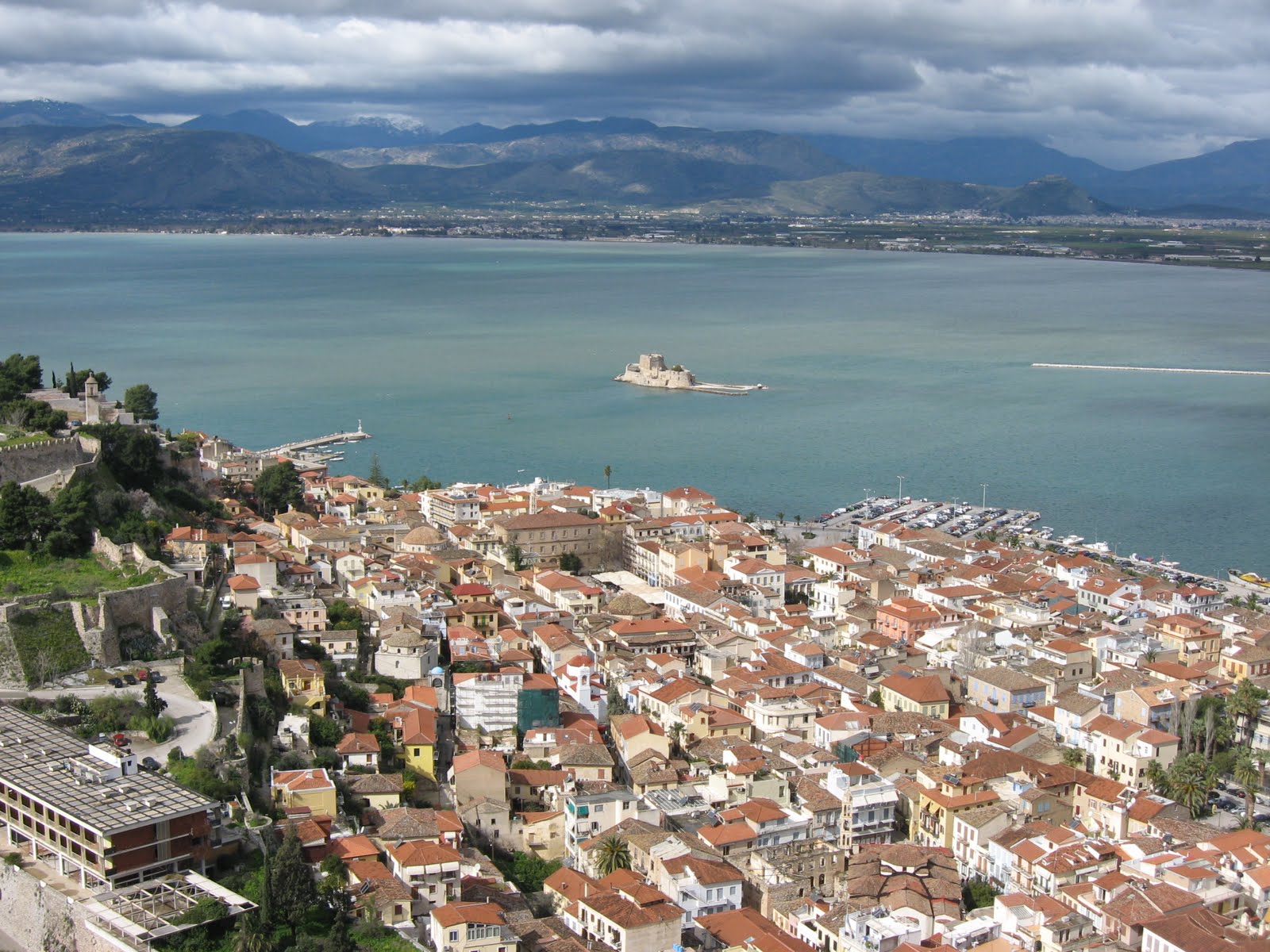
Quite a view from up there – over the city, the Acronafplia peninsula – the other fortification of Nafplio predating the Palamidi – the port and the fortified islet of Burdzi guarding its entrance, and the Argolic Gulf that gives on the Aegean Sea.
In following the history of the construction of the various bastions of the Palamidi and that of the Acronafplia, you learn as well quite a bit about the history of Greece or certainly of that key region, mainly characterized by successive “dominations” of foreign powers:
• Starting with the Byzantines, as early as the 6th century A.D., who added to the already existing fortifications of the Acronafplia;
• The Franks succeeded, when French crusaders took the city in 1212 and kept it until 1388 (i.e. some 175 years);
• 1388 is when it was sold to the Venetians – first “domination”, from 1389 to 1540 ( i.e. a good 150 years), during which time the city expanded and more fortifications to the Acronafplia were added;
• The Turks took it back in 1540, and kept it for almost another 150 years, until 1686;
• The Venetians regained the place, and held it from 1686 to 1715 (29 years). That is when the Palamidi castle was built – the last major construction of the Venetian empire overseas;
• The Turks retook it easily again in 1715 (the Palamidi Castle was weakly defended by no more than some 80 soldiers, we are told); the Ottomans kept it for more than a hundred years;
• When in 1821 the Greeks fought hard to take it (they starved the city for a year or so), as part of the War of Independence which gave them back their homeland shortly after.
Nafplion then became the seat of the Government of the newly liberated Greece, where its first leader, Count Ionnis Kapodistrias, was assassinated in the fall of 1831 (by members of some rival family). That is when royalty was established (?) in Greece with King Otto who eventually moved the capital to Athens in 1834.
Nafplion is still very much a port city – you can see that from the top of the Pamalidi with the expansion of the new town – but it has developed very much also as tourist destination (the old city is full of hotels and little “pensions”), especially as a weekend destination for nearby Athenians, as it is blessed by a sunny climate, milder than the average Greek weather, which also attracts other Europeans beyond Athens.
Lunch at Kiros Restaurant, on fried feta and sesame for appetizer, and veal and dolmades for main courses (with cats mating on awnings covering the courtyard!)
Walked along the port and all around the Acronafplia, to come back at the foot of the Pamalidi, and eventually the hotel. Late afternoon, walk in town, the Ayios Spyridon church (Greek orthodox?) next to the hotel, where Kapodristrias was assassinated (see above), the Constitution Square, the Archeological Museum (built in the early 18th century as the arsenal for the Venetian fleet), the “Voulevtiko” mosque (built in 1730, then served to host in 1825 the first Parliament of the new Greece), the Nafplia Palace Hotel (great location, almost at the top of the Acronafplia, facing the port; a bit run down though – maintained at a minimum cost?). Dinner at Savouras Restaurant, a fish place on the harbor – fresh dorade and French fries, Greek salad + feta cheese!
Nafplio, Greece, February 20, 2011
This Friday I flew from sunny (today) Barcelona to rainy (today) Athens. Cynthia, from Toronto (left yesterday). We were driven directly from the airport (where Cynthia & I joined, our flights arriving just about the same time - not a coincidence, but due to careful travel planning!) to Nafplion (invariably referred to also as Nafplio), less than 2 hours away, in the northeast of the Peloponnese peninsula.
Nafplion, the first capital city of modern Greece (we are reminded often – it was the case for no more than 5 or 6 years after the end of the War of Independence, until 1834 when it was moved to Athens). Gives on the Argolic Gulf. Staying at Aetoma (pronounced “Aitoma”) Hotel, a very small boutique hotel (5 rooms – we are at the top with a lovely balcony which we may use if the rain stops while we are there!) http://hotel-aetoma-nafplio.focusgreece.gr/
Dinner nearby (at the Phanaria Restaurant); on slouvaki (veal & chicken) and spinach pie, with house red wine (great simple food, still 25Euro). What is interesting with these small villages is that they may be dating back centuries, but they are very modern – one particular womenswear store we walked by had wonderful, slick design clothes… Went to bed with the sound of rain falling on the shower sky window, nice…
Feb 19
Saturday morning; the rain stops. Earthly breakfast at the hotel (prepared and served by the owner – cut fruits, Greek yogurt and honey, cheese and ham omelet, chocolate and coconut cakes, coffee and fresh orange juice – this must be the season, orange trees are everywhere and loaded of fruits!). We had to walk this breakfast off. Climbed up to the Palamidi, a series of bastions (8 of them) built on a high cliff that dominates Napflion. Climbed up hundreds of steps (999 of them, the popular belief has it; 857 according to a more authoritative source – we did not count them!)
Quite a view from up there – over the city, the Acronafplia peninsula – the other fortification of Nafplio predating the Palamidi – the port and the fortified islet of Burdzi guarding its entrance, and the Argolic Gulf that gives on the Aegean Sea.
In following the history of the construction of the various bastions of the Palamidi and that of the Acronafplia, you learn as well quite a bit about the history of Greece or certainly of that key region, mainly characterized by successive “dominations” of foreign powers:
• Starting with the Byzantines, as early as the 6th century A.D., who added to the already existing fortifications of the Acronafplia;
• The Franks succeeded, when French crusaders took the city in 1212 and kept it until 1388 (i.e. some 175 years);
• 1388 is when it was sold to the Venetians – first “domination”, from 1389 to 1540 ( i.e. a good 150 years), during which time the city expanded and more fortifications to the Acronafplia were added;
• The Turks took it back in 1540, and kept it for almost another 150 years, until 1686;
• The Venetians regained the place, and held it from 1686 to 1715 (29 years). That is when the Palamidi castle was built – the last major construction of the Venetian empire overseas;
• The Turks retook it easily again in 1715 (the Palamidi Castle was weakly defended by no more than some 80 soldiers, we are told); the Ottomans kept it for more than a hundred years;
• When in 1821 the Greeks fought hard to take it (they starved the city for a year or so), as part of the War of Independence which gave them back their homeland shortly after.
Nafplion then became the seat of the Government of the newly liberated Greece, where its first leader, Count Ionnis Kapodistrias, was assassinated in the fall of 1831 (by members of some rival family). That is when royalty was established (?) in Greece with King Otto who eventually moved the capital to Athens in 1834.
Nafplion is still very much a port city – you can see that from the top of the Pamalidi with the expansion of the new town – but it has developed very much also as tourist destination (the old city is full of hotels and little “pensions”), especially as a weekend destination for nearby Athenians, as it is blessed by a sunny climate, milder than the average Greek weather, which also attracts other Europeans beyond Athens.
Lunch at Kiros Restaurant, on fried feta and sesame for appetizer, and veal and dolmades for main courses (with cats mating on awnings covering the courtyard!)
Walked along the port and all around the Acronafplia, to come back at the foot of the Pamalidi, and eventually the hotel. Late afternoon, walk in town, the Ayios Spyridon church (Greek orthodox?) next to the hotel, where Kapodristrias was assassinated (see above), the Constitution Square, the Archeological Museum (built in the early 18th century as the arsenal for the Venetian fleet), the “Voulevtiko” mosque (built in 1730, then served to host in 1825 the first Parliament of the new Greece), the Nafplia Palace Hotel (great location, almost at the top of the Acronafplia, facing the port; a bit run down though – maintained at a minimum cost?). Dinner at Savouras Restaurant, a fish place on the harbor – fresh dorade and French fries, Greek salad + feta cheese!
Nafplio, Greece, February 20, 2011
samedi 19 février 2011
Barcelona – once more!
Cold again in Barcelona. Back to attend this year’s Mobile World Congress.
Staying at the same flat, “39 steps” – a bargain at this time when hotel prices are considerably jacked up because of the conference that brings in some 50,000 people – just off La Rambra.
The little time I have to myself, outside of the Congress, I have passed it meandering, under the rain, in the streets of El Born, the heart of the old city.
Fascinating church to visit, Esglesia de Santa Maria del Mar, a monument of pure Catalan gothic style (it was built around the 14th century in a mere 60 years– no time for different styles to mix!) Very sparely decorated – thanks in part to anarchists of the beginning of the 20th century, we are told, who “freed” it of any “decorations” it may have had…
Walked to the old market (“L’Antic Mercat del Born”) under heavy reparations (Carrer del Comerç)
Gentrification has been underway for some time now, judging by the upscale stores (Carrer del Rec) and restaurants around. Real estate prices have come down somewhat , given the deplorable state of Spain’s economy, but they were too high to start with, as a young professional in the business who lives nearby commented to me.
A peek into the Picasso Museu along Carrer de Montcada in a series of medieval buildings – no time but to wander into the museum bookstore (get a 2007 photography taken in the “Bonsucces” street, where “39 steps” is, the latest edition – 2011 – of Wallpaper City Guide on Barcelona…and an introduction book for children on Picasso, “en français” for little Béatrice!).
Meandered back to La Rambla via the Barri Gotic neighborhood (Catedral, still under renovation;got myself a few warm wool sweaters at a shop there (Joana M. Prat – www.joanamprat.cat).
Note to myself: next visit, go to the Pedrables Monastery with its 40 meter long Gothic style cloister, and home to a museum that houses the Thyssen Bornemiza Collection.
February 17, 2011
Staying at the same flat, “39 steps” – a bargain at this time when hotel prices are considerably jacked up because of the conference that brings in some 50,000 people – just off La Rambra.
The little time I have to myself, outside of the Congress, I have passed it meandering, under the rain, in the streets of El Born, the heart of the old city.
Fascinating church to visit, Esglesia de Santa Maria del Mar, a monument of pure Catalan gothic style (it was built around the 14th century in a mere 60 years– no time for different styles to mix!) Very sparely decorated – thanks in part to anarchists of the beginning of the 20th century, we are told, who “freed” it of any “decorations” it may have had…
Walked to the old market (“L’Antic Mercat del Born”) under heavy reparations (Carrer del Comerç)
Gentrification has been underway for some time now, judging by the upscale stores (Carrer del Rec) and restaurants around. Real estate prices have come down somewhat , given the deplorable state of Spain’s economy, but they were too high to start with, as a young professional in the business who lives nearby commented to me.
A peek into the Picasso Museu along Carrer de Montcada in a series of medieval buildings – no time but to wander into the museum bookstore (get a 2007 photography taken in the “Bonsucces” street, where “39 steps” is, the latest edition – 2011 – of Wallpaper City Guide on Barcelona…and an introduction book for children on Picasso, “en français” for little Béatrice!).
Meandered back to La Rambla via the Barri Gotic neighborhood (Catedral, still under renovation;got myself a few warm wool sweaters at a shop there (Joana M. Prat – www.joanamprat.cat).
Note to myself: next visit, go to the Pedrables Monastery with its 40 meter long Gothic style cloister, and home to a museum that houses the Thyssen Bornemiza Collection.
February 17, 2011
S'abonner à :
Messages (Atom)