vendredi 16 janvier 2015

Tunisia – January 2015.


No question! I am in Muslim country: the call for prayers has just been heard (it’s 5:30pm)!


Arrived to Tunis from Malta (one hour flight on a turbo propeller jet – an ATR72) and found my way to the hotel in the Medina: not easy! I am staying in an old mansion, Dar El Medina, that has been converted! Here is how it is described: “There’s no hotel like this in Tunis. Not only is it an elegant 12-room boutique in a gorgeous traditional house, but it’s right in the medina - Tunis’ UNESCO-listed inner city, founded by the Arabs in the 8th century. And it's been in the same family since it was built in 1825. Whitewashed and tiled, with latticed windows, the many-levelled mansion is a surprise after the narrow street, with inner courtyards providing light, space and shade.” No central heating though! (Heating would be required at this time of the year, if only to chase the humidity!)


The Medina reminds me of scenes in one of Tintin’s albums; same look, picturing an older gentleman in a jelaba walking down the narrow street with the tower of a mosque as a backdrop! Lots of cats in the streets – Cynthia tells me (on Skype, because she is not with me!) that is how they chase the rats away! No dinner tonight: everything is closed (Sunday night!) The hotel attendant prepared me an omelette!


The day after, it is Carthage! (See separate entry.)


Went to Bardo National Museum, in the renovated 13th century-built palace for the beys during the ottoman-administered period (the museum was created in 1888 and fully renovated in 2009 – much too much!) and renowned for its collection of antique mosaics (collected on sites around the country, for various reasons!).

Then, around lunch time, took a cab and went to see roman ruins at Oudhna (Uthina) some 30 kilometers from Tunis. D’abord l’amphithéâtre: bâti à flanc de montagne (colline), on pouvait y assoir quelques 16,000 spectateurs. J’ai visité avec le chauffeur de taxi et descendu dans, et puis sous, l’aréna. La restauration est en cours (comme pour le reste du complexe) Et puis le Capitole, la Citerne du Forum, les Grands Bains Publics, etc. Les céramiques ont été remisées au Musée Bardo pour sauvegarde. De retour à Tunis vers la fin de la journée…


Diner au Dar Bel Hadj in the medina (lamb, again!)

La Médina tunisienne! Promenade, au hazard! Lunch sur le pouce (pizza) mais dîner avec un couple (mari et femme) de Suisses qui demeure aussi au Dar El Medina au restaurant Essayara, dans la médina.

Pour la visite à Dougga, voir l’entrée singulière sur le sujet!
I returned for dinner at the Dar Bel Hadj mainly to listen to the oriental cithare (an Iranian 8th century invention) player.
Weather: sunny but chilly (around 17 degrees) except in the afternoons (warmer); all week

I notice that for one woman dressed and fully covered (I saw only 2 on the street!), there are one hundred women that are satisfied with the shawl only and 2 hundred totally modern (without any sign of belonging to Islam). 

 Tunis, January 16, 2015

samedi 3 janvier 2015

Is Venice sinking?

Following is an article by NBC that appeared a few years back (surprised that he did not mention the most famous name the city is known by: the Seranissima!):
"

Stefano Rellandini / Reuters
Gondoliers row gondolas with tourists in a canal in Venice in this May 7, 2011 file photo.


ROME -- Venice appears to have more nicknames than street names. It’s known as the "Queen of the Adriatic," the "City of Water," "City of Masks," "City of Bridges," "The Floating City," and "City of Canals."
But is Venice destined to become "The Divers' Paradise" much faster than we thought? New research by U.S. scientists suggests it is sinking more than five times faster than experts in Venice believe.

Saying that the city is sinking is just about as obvious as saying that the wind will always blow in Chicago. It’s just a thing of nature. And there’s nothing anybody can do to stop it.
While Venetians and tourists know that Venice's appeal is due to its undeniable beauty, with its Gothic and Byzantine palazzos appearing to float on the canals and lagoon, much of the city's allure comes from the fact that it appears to be disappearing.
So you don’t need a scientist to tell you that Venice is sinking. In fact, sometimes they tell you otherwise. Back in the 1980s Venetians rejoiced at the news that the city had finally stabilized.  But, to use an Italian sailor’s jargon, that theory “loses water from all sides.”
It’s quite obvious to the naked eye (or rather, to the naked ankle when it floods) that parts of Venice are flooding more and more often. To tourists, walking in a flooded St. Mark’s Square might be a unique photo opportunity, but to Venetians it’s a sign of things to come.
So Venice is sinking. But the question remains -- how long will it take before it turns from floating jewel to a playground for divers?
The answer comes from a new research by the Scripps Institution of Oceanography at the University of California, expected to be published on Wednesday: Venice is still sinking, and sinking at a rate of up to two millimeters per year (0.08 inches).

There’s more. Not only is the city being reclaimed by the waters that made it famous, it now looks like it’s actually heading out to sea, as if the glorious capital of the former Maritime Venetian Republic is tired of being a tourist attraction and wants to die in the Adriatic.
According to measurements taken over 10 years, Venice is also tilting a bit, about a millimeter or two eastward per year. While this doesn’t mean that you should buy a ticket right away in order to see Venice before it disappears, it raises concern that not enough is being done to save it. 
A complex system of moving dams around Venice that took decades and millions of dollars to build is nearing completion. The new research could well call into question whether these major works will actually be enough to save the “Floating City.”
One of the biggest experts on the state of Venice, Luigi Tosi, of Italy's National Research Center, pointed out that Venice's "sinking" was actually a combination of land subsidence and sea level rise.
He said the Scripps researchers' results "tell us nothing new." "We have published a paper back in 1992 that arrived to the same conclusions," he said.
But experts at Consorzio Venezia Nuova, the group in charge of safeguarding Venice and the lagoon, told NBC News they had a lot of questions about the Scripps report, saying they thought the city was sinking much more slowly.
“I learned about the new research from journalists like yourself,” said an official who asked not to be named. “We have records of the subsiding of Venice for hundreds of years, and yet they haven’t called us."
But one thing is clear to the official -- 10 years of measurements might sound a lot to most people, but on Venice’s standards it’s the blink of an eye.
"We have calculated that the city has been sinking three to four centimeters (about 1.5 inches) per century," the official said.
That's not to say the people at Consorzio Venezia Nuova aren't paying attention, however.
"Now they say two millimeters per year…that means Venice would sink 20 centimeters (7.8 inches) every 100 years. That’s more than five times more than we calculated. So I’ll believe it when I see it," he said.
It’s unclear whether the Scripps Institute team will contact the Consorzio before the research is published on Wednesday.  But one way or another their difference will have to be reconciled … and it will be, once again, just water under the bridge".

Here is another one on the subject by Rich Steves:

 'By Rick Steves and Gene Openshaw
Venice has battled rising water levels since the fifth century. But today, the water seems to be winning. Several factors, both natural and man-made, cause Venice to flood about 100 times a year — usually from October until late winter — a phenomenon called the acqua alta.
On my last trip I asked a Venetian how much the city is sinking. He said, "Less than the sea is rising." Venice sits atop sediments deposited at the ancient mouth of the Po River, which are still compacting and settling. Early industrial projects, such as offshore piers and the railroad bridge to the mainland, affected the sea floor and tidal cycles in ways that made the city more vulnerable to flooding. Twentieth-century industry worsened things by pumping out massive amounts of groundwater from the aquifer beneath the lagoon for nearly 50 years before the government stopped the practice in the 1970s. In the last century, Venice has sunk by about nine inches.
Meanwhile, the waters around Venice are rising, a phenomenon that's especially apparent in winter. The highest so far was in November 1966, when a huge storm (the same one that famously flooded Florence) raised Venice's water level to more than six feet above the norm. The notorious acqua alta happens when an unusually high tide combines with strong sirocco winds and a storm. Although tides are miniscule in the Mediterranean, the narrow, shallow Adriatic Sea has about a three-foot tidal range. When a storm — an area of low pressure — travels over a body of water, it pulls the surface of the water up into a dome. As strong sirocco winds from Africa blow storms north up the Adriatic, they push this high water ahead of the front, causing a surging storm tide. Add to that the worldwide sea-level rise that's resulted from recent climate change (melting ice caps, thermal expansion of the water, more frequent and more powerful storms) and it makes a high sea that much higher.
If the acqua alta appears during your visit, you'll see the first puddles in the center of paved squares, pooling around the limestone grates at the square's lowest point. These grates cover cisterns that long held Venice's only source of drinking water. That's right: Surrounded by the lagoon and beset by constant flooding, this city had no natural source of fresh water. For centuries, residents carried water from the mainland with much effort and risk. In the ninth century, they devised a way to collect rainwater by using paved, cleverly sloped squares as catchment systems, with limestone filters covering underground clay tubs. Venice's population grew markedly once citizens were able to access fresh water by simply dropping buckets down into these "wells." Several thousand cisterns provided the city with drinking water up until 1886, when an aqueduct was built (paralleling the railroad bridge) to bring in water from nearby mountains. Now the wells are capped, the clay tubs are rotted out, and rain drains from squares into the lagoon — or up from it, as the case may be.
So what is Venice doing about the flooding? Since the 1966 flood, officials knew something had to be done, but it took about four decades to come up with a solution. In 2003, a consortium of engineering firms began construction on the MOSE Project (which was expected to be partially operational this year...but funding problems have brought still more delays). Named for the acronym of its Italian name, Modulo Sperimentale Elettromeccanico, it's also a nod to Moses and his (albeit temporary) mastery over the sea.
Underwater "mobile" gates are being built on the floor of the sea that will lie flat at the entrances of the three inlets that lead from the open sea into Venice's lagoon. When the seawater rises above a certain level, air will be pumped into the gates, causing them to rise and shut out the Adriatic"

December 31, 2014

Venice in December - 2


Murano Island: where glass things are made! On December 30, we went there by vaporetto (people came right to the B & B by foot to pick us up!), about more than half hour away from Venice, and “visited” one of the major factories – Vitreria Ducale (that is a very short demo by an artisan working a piece of hot glass, and the rest of the time spent in the showroom! – Cy satisfied her craving and bought a piece) Walked in the bitter cold along the canal to the restaurant - Acquastanca Restaurant (showing up a full hour before our reservation), but a very quaint place…and very good! For starters, we had the very traditional salted cod mixed in seed oil, followed by the main course, a piece of john dory and of sea bass, plus a bottle of local (North of the Veneto: Fruli Venezia Gulia) white wine (Kyber).

In the afternoon (5pm), attended the annual concert for the yearend (concerto di Capodanno) at Teatro La Fenice; it was a late decision: we have been sitting in better places before but this time we had to buy tickets in person the day before (I had tried on line much before but it did not work!)  We were rewarded though by beautiful music (aria from Puccini and Verdi, with the orchestra and the choir of the theatre and a few renowned soloists). We had booked dinner at a very small place (a few tables and the kitchen) in the Castello district – CoVino (hinted by the NYT!): what a great choice it turned out to be! Spectacular! The food (we had as starters the soup and the pasta, and as main course, the mullet and ...), the wine (a glass of Proseco – the best Cy ever had! – and a bottle of light red from Linguria), the original maître d’ and host, Andreas, (the son of the brewer who did the natural Proseco, Mauro Laurenzon) and the company (a couple from Australia, with their 3 pre-teen children)!
The day after, we went back early to the piazza San Marco, to visit the Basilica; (while there, read parts of a 1989 Michelin green guide on Italy on the basilica; see also St.Mark’s Basilica by Maria Da Villa Urbani and titbits in Venise, Insolite et Secrète) spend a good part of 2 hours there before coming back to the B&B, to get direction (and reservations!) for lunch at fiaschetteria Toscana (recommended by Alyssa at the B&B): excellent! Cy had a starter and a simple pasta with truffle as main dish; I had a pasta with shrimps as an entrée, and a grilled sea bass as main course + a bottle of white wine from the same region (near Trieste in Firuli-Venezia Giulia, close to the border with former Yugoslavia) as yesterday, an unfiltered 2011 bottle from the winemaker Zidarich (Malvasia grapes).

That evening (before our departure at 4:15am!), we spend it at the opera – Il Barbiere di Siviglia – unusually played for a very small audience in a palace (Palazzo Barbarigo-Minotto which faces the Grand Canal - two different buildings that merged in the XVIIth century - and has become the base of “Musica a Palazzo”, the association we had to become members of to attend the opera!), going from one room to the other (3 times)!

Slept very little to take the water-taxi that came in the middle of the night to pick us up and take us to the airport!

December 31,2014

Venice in December - 1


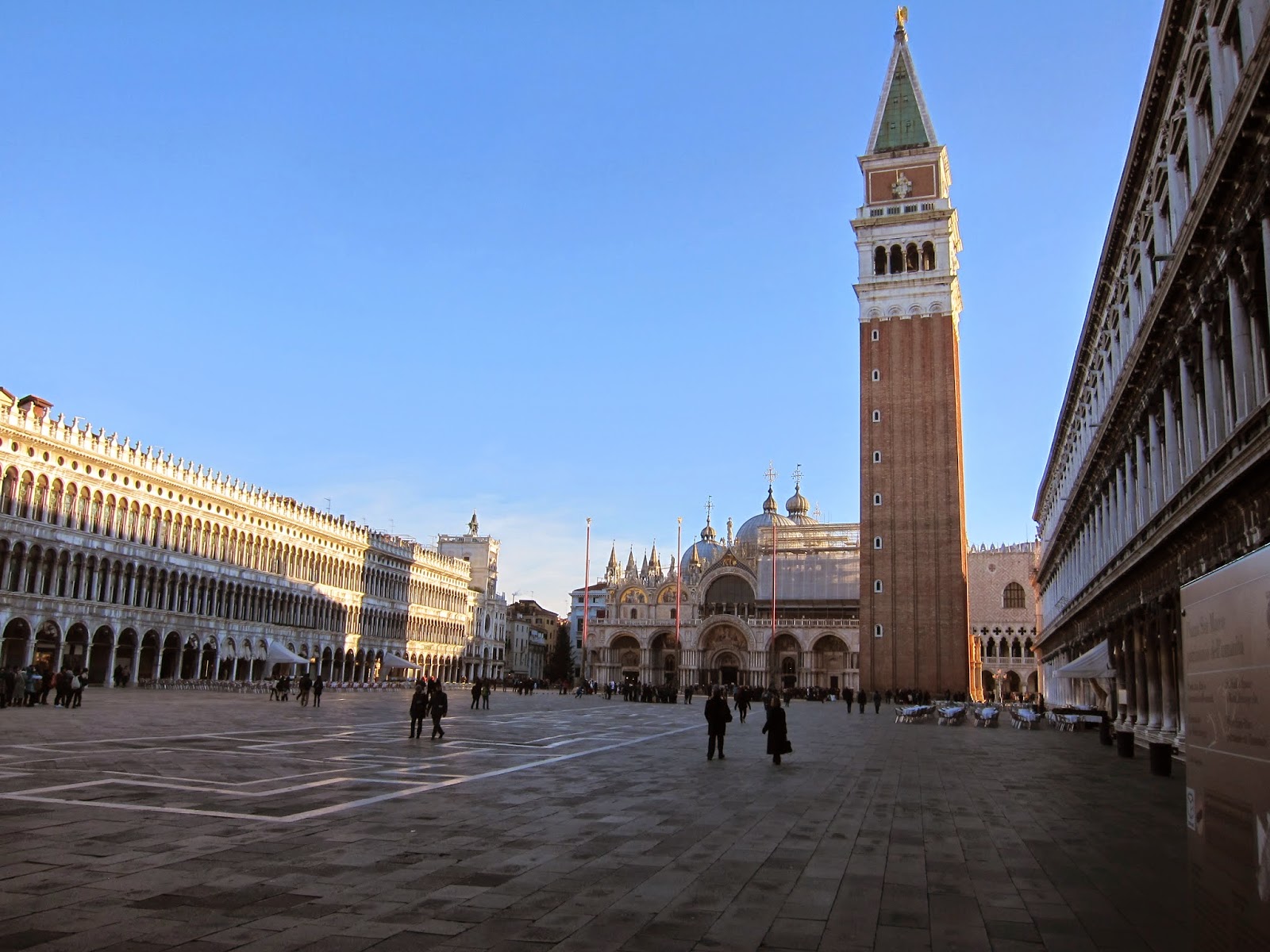
We leave Gozo, it is 12 degrees centigrade (the weather had just turned and the Grigal had settled in (with its usual forceful wind!). After two short flights (via Rome), there we are: Venice, the unsinkable sinking city, full of canals (rio)! And 2 degrees centigrade! It’s cold and I had not realized it was that cold even at this time of the year! Nor I had realized that there would still be that many visitors in Venice at this time of the year (mostly from the Orient)! (For one reason or another, Venice seems to be a favorite destination at this time of the year for Europeans– Xmas and New Year! Lots of French heard around also!) But I am a bit anticipating!

 From the airport we take a private water taxi and half an hour later we are at our B&B, Gio & Gio, deep into San Marco! It is a former residence, converted some years ago into a small B&B, with 3 bedrooms – very cosy! We are recommended that evening a few places to get a bite to eat nearby (it’s past 8pm), but we could not find any of them and end up at a restaurant that I recognized (actually the B&B had recommended it before in an email!), a beccafico, not too far away: good place (simple fare: stuffed calamari and a plate of vermicelli covered with some sardine residue and glasses of wine – Pinot Grigio and something else), even if not planned!

After a light breakfast (and a sleepless night as usual!), walked to San Marco piazza, and spent the morning visiting the Doge’s Palace: spectacular! Don’t have time to visit anything else! After a cappuccino in late morning at a café (Café Lavena) on the piazza (the most expansive one ever at 8 Euros and a half each!), decided would come back to visit the cathedral on Wednesday morning and went back to the B&B located not too far away (pit stop at the nearby ATM to collect cash to settle the account at the B&B). The piazza is full of people: if this is like this at the end of December, I can’t imagine what it is like in July! Lunch: walked back nearby the piazza at restaurant where I had booked days before via the B&B, Osteria Enoteca San Marco, for a copious meal (foie gras and tagliatelle ragu that we shared, with a half bottle of Barolo, and secondi platti (veal liver for Cy and sea bass for me, with a glass of wine) – all delicious! In the afternoon, forewent the cruise on the Grand Canal (it’s too cold!) for a well-deserved rest, at the B&B (after a short walk to the Teatro La Fenice to get tickets for the concert tomorrow afternoon) 

The evening is spent at Teatro San Gallo, to see a video and a play (in English), both on the history of Venezia. We are reminded of the historical importance of the place, its fights against Islam (revisionism?), its trading network, Marco Polo, its artists, Titian, Canaletto, Casanova (le débauché!), Vivaldi, etc.

Dec 29, 2014

vendredi 5 décembre 2014

Stockholm, in December!

Third visit in this city! Did not realize how fast the darkness was coming down here, at this time of the year (3h30, and it was night time!) Staying at the Lydmar Hotel, next to the Grand Hotel. More intimate! Very good dinner at Frantzen (see menu and write-up under country file!).


Business meeting in morning; lunch (and breakfast) at the hotel. Visit at local (global!) heroes museum: the ABBA museum – music business oblige! Walked to it (on Djurgarten) but took the ferry coming back!

jeudi 27 novembre 2014

Bruxelles en novembre!


Un climat typiquement belge, Un ciel couvert et gris, comme je me les rappelle! Le pavé mouillé!

Une matinée d’affaires; bouquinage chez «passa porta » sur Danseart; déjeuner à coté chez «Bonsoir Clara» (cabillaud et mousse au chocolat); achat (pour Cy) à une boutique locale…

En après-midi, je me rends en métro à l’Atomium  Le symbole de Bruxelles » comme dit la publicité), tout au nord de la ville. Souvenir de l’Expo ’58! Tout près du stade (est-ce le stade du Roi Beaudoin - renommé en 2000 - où s’est produite la tragédie (39 victimes) dite de « Heysel »  en 1985?  À l’intérieur (des bulles); une exposition sur le design belge à travers les âges. Temps humide; on distingue à peine l’Atomium  (métallique) sous ce ciel tout gris!

Diner chez «Comme chez Soi» (pas loin de l’hôtel): 4e génération depuis 1926! Petit mais mémorable cuisine (voir entrée séparée dans le fichier Belgique). Dans un endroit style Art Nouveau, comme si c’était de Horta, mais l’endroit a été reconstruit en 1988!

Le lendemain : travail et exercice à l’hôtel (l’Amigo). Départ, sur Paris par train, et Fontainebleau par taxi.

Bruxelles, le 27 novembre 2014

mardi 4 novembre 2014

Brazil – Fall of 2014


Long flight to Sao Paulo from Toronto (10 hours; I slept the first 3 – I left Paris that morning and had 6 hours overlay in Toronto! - but was awake for the remaining 7!)

First time in Brazil, this enormous country (if you look at a map, it is more than half of South- America, and half of its population – about 200 million people, made up of ‘diversity’ at all levels – race from everywhere – but all “Brazilian” in the end! – money-wise, etc.). Portuguese!

Sao Paolo, a real metropolis: Sao Paolo is the largest city of the country – municipality: 12 million people; metro area: 20 million (not that I counted them but wikipedia says! – if not of all the Americas. One of the largest of the world. Home of such museums as that of the Museum of Ipiranga, the São Paulo Museum of Art, and the Museum of the Portuguese Language. It is the site of the Brazilian Grand Prix of Formula One;  it is the host  of the world's largest gay pride parade. People from the city of São Paulo are known as paulistanos. The city is also colloquially known as "Sampa"; and also the "Cidade da Garoa" (city of drizzle) apparently.
 

The Intercon hotel (where I am staying) is very close to the Avenida Paulista, the emblematic thoroughfare of Sao Paulo with all its tall buildings! I walked down the street to nearby MASP (Museu de Arte de Sao Paulo). It is a private non-profit institution founded in 1947 by a local media tycoon,  Assis Chateaubriand, and an Italian art lover who became its first director,  Pietro Maria Bardi (a museum created in this city, rather than Rio where it was presumably intended, because that is where the money is –and a lot was needed to get it going!) It is lodged in a 2-story concrete and glass building, representing the modern architecture of Sao Paulo, built at the end of the sixties – I don’t like it much!. Free of charge that day! Mostly temporary exhibitions: photography “CIDADES INVISÍVEISon the first floor, and paintings: “PASSAGENS POR PARIS - ARTE MODERNA NA CAPITAL DO SÉCULO XIX”; “O TRIUNFO DO DETALHE (E DEPOIS, NADA)”; and “DEUSES E MADONAS - A ARTE DO SAGRADO” on the second.^I rember among others a few Modiglianis. (It is well known internationally for its permanent European art collection but I did not find\see it – nor was I gone there for that!)

Business meeting in Centro – busy streets!

Had dinner on the second night  at KAA, a favorite of my guest, a Canadian who works for a French firm (Thales)in Sao Paulo for the last 4 years and whom I knew from Shanghai (Alcatel)! A restaurant full of Atlantic plants! (They have a green wall – I did not see much of it as I was seating my back to it!) I had a Brazilian specialty, a fish cooked iin some local sauce – I cannot find the menu on line! Very good though!


Rio de Janeiro: flew from Sao Paulo and arrived at Santos Dumont airport at about lunch time andit took about one hour to fly! (Santos-Dumont who spent most of his life in France is a local hero of the aviation industry!) Staying at Santa Teresa Hotel (the pool,above) in the Santa Teresa neighborhood. French-developed; very nice! Had lunch at the hotel restaurant, Tereze: very good fish (grouper, in a very delicate sauce!)


Went to walk on Copacabana Beach, (half hour car ride from hotel) around the Copacabana Palace hotel (where I took the phone call from AGS succession manager); very Miami-like, with tall residential buildings all along the avenue that borders the beach!

Breakfast every morning at the Tereze (hotel designated place for breakfast) at 7H – good spread; could have eggs for same price!

Spent the day after arrival on business, at offices far away in Bahia (on Avenida Das Americas) Came back along the coast (one hour and a half in the heavy Friday traffic - twice as long than otherwise!) Went by several beaches – San Conrado; Vidigal, Leblon – before fabled Ipanema and Copacabana…Drove by another beach, Botafogo -  almost abandoned because it gives on a harbor dirty with leaked oil I suppose! Gone as far as the height of the Santos Dumont airport before going up to SantaTeresa!

Dinner at Aprazivel , one of the better restos in Brazil. I was told – not bad but noisy I found

Watched a documentary (on TV5, from Radio-Canada!) on Rio by night!  Dancing everywhere! Poverty does not seem to take the “joie de vivre” away from people!


Early morning visit to the Cristo Redentor, this 38 meter-high statue of Jesus-Christ, built (1921-31) on top of the Concovado (it sits at some 700 meter-high), facing the other site so defining Rio iin the imagination of people, the Sugar Loaf. The statue, considered to be Art Deco work, because of its design but also because of the 3-centimeter mosaic pieces from Paris that cover it, is a huge attraction for tourists, Brazilians or otherwise. Thereis a little chapel in the base of the statue…and devoted people (Catholics I would think) praying out loud (with a PA system) in front of the statue!... It is located in a jungle, the Parque Nacional da Tijuca, through which you gently drive! We stopped on the drive back (at the driver’s suggestion) at a place that seems not to be well-known, to admire the view on both sides…


Went then for a bicycle ride (did not think about my current condition of dizziness before I rented!) along Ipanema Beach, all the way to Leblon neighborhood, for lunch on Rua Dias Ferreira where one finds a succession of stark, modern restos, serving mainly International cuisine (settled on restaurante Quadrucci)

Visited temporary exhibitions at the Museu de Arte do Rio (MAR) in Centro. One of the temporary exhibitions focused on favelas: I understood where these rather poor urban settlements - there are apparently 800 in Rio some very small, some very large – come from (arriving black slaves in the 18th and 19th century squatted in the periphery of existing habitations and started a trend!)


Could not pass the cable ride to the top of the Sugar Loaf! It’s done in two steps: first on top of … then off to the top of the Sugar loaf. Magnificent view (360 degrees) of all Rio. This is the third cable system installed (in 2008); the first one (German) was in 1912 (only the 3rd system ever in the world at the time), and the second one in 1972 (Italian)


Rio is getting ready for the Summer Olympic Games (5 to 21 of August in 2016). This is a prelude to a future visit!?...
Rio de Janeiro, Nov 3 2014