About the so-called prediction by the Mayas…
We were explained, by a Maya descendant herself, that actually what it means is the end of a cycle in the Maya calendar (the 5,125 year “Great Cycle of the Ancient Maya Long Count Calendar” – in other words the current Maya calendar runs out!); not “the end of the world” – what it has become to be interpreted as! Passed that fatidic date, the Maya pronouncement means, there will be an adjustment – within the 5 following days when the calendar will adjust itself to the state of the cosmos at the time (5 days that won’t exist – or be recorded!) – and then a new calendar cycle will start. The Maya twist: the Maya will then become again respectable!
A note from an entry in Wikipedia (http://en.wikipedia.org/wiki/2012_phenomenon) : “December 2012 marks the conclusion of a b'ak'tun—a time period in the Mesoamerican Long Count calendar which was used in Central America prior to the arrival of Europeans. Although the Long Count was most likely invented by the Olmec, it has become closely associated with the Maya civilization, whose classic period lasted from 250 to 900 AD. The writing system of the classic Maya has been substantially deciphered, meaning that a corpus of their written and inscribed material has survived from before the European conquest.
“Unlike the 52-year Calendar Round still used today among the Maya, the Long Count was linear rather than cyclical, and kept time roughly in units of 20: 20 days made a uinal, 18 uinals (360 days) made a tun, 20 tuns made a k'atun, and 20 k'atuns (144,000 days or roughly 394 years) made up a b'ak'tun. Thus, the Mayan date of 8.3.2.10.15 represents 8 b'ak'tuns, 3 k'atuns, 2 tuns, 10 uinals and 15 days.” (More details:http://en.wikipedia.org/wiki/Mesoamerican_Long_Count_calendar)
Suchitoto, February 18, 2012
samedi 18 février 2012
Suchitoto (no, it is not Japanese!)
Driven back from Los Caracoles to Suchitoto by Pascal & Joaqim, the owners of the guest house (and of the hotel where we are going to be staying in that city, Los Almendros de San Lorenzo). Stopped for a bite at their new restaurant, Bistro de San Lorenzo (in case you wonder, Lorenzo, it’s the dog!) in San Salvador. They were kind enough to give us a couple of hours to visit both museums nearby – Museo National de Antropologia Dr. David J Guzman (Pascal oriented us to room 5 – a history of the country through religion - fascinating: such a contrast between the pre-Hispanic and the colonial periods!), and Museo de Arte de El Salvador (special exhibition of local painting artists since the 19th century), both recent constructions.
Drive to Suchitoto, 47km north of San Salvador, late afternoon.
 Suchitoto is a small town (but a city; ciudad – 5,000 people, but many more around the city proper, perhaps some 20,000). It seems though to be an important one, in the region (further north from San Salvador, but still geographically central). The name would actually mean “place of birds and flowers” in Spanish! The cultural centre of the country, they say. Perhaps because its colonial, Hispanic character has been preserved, cobbled stone streets and all! Although most of the buildings have been erected after the independence (1821), including the beautiful church of Santa Lucia (mid 19th century - picture above) – one has to see the wooden-columned interior, long and narrow (picture below) – that dominates the main square (Parque Centenario) where, at the other end of it, sits Las Puertas Hotel (where Cynthia stays when the more luxurious Los Almendros – see below – is fully booked), which was we are told a jail a one point, converted into a bordello (!), then in a hotel – the rooms are upstairs, on the second floor, each with a balcony that must offer a unique take over the square.

There is the “International Permanent Festival of Art and Culture” going on in February every year (the XXII edition this year!). This weekend, there is a performance by two Mexican artists, a pianist and a guitarist… Paid a visit to the art gallery across the street, called Galeria Pascal (guess who is the owner!) where there is a photo exhibition of pictures of Suchitoto by the wife of a German diplomat on posting in El Salvador; interesting…
Suchitoto is also the place where the Stratford Shakespeare Festival theatre company from Ontario has chosen to help a local group – EsArtes – to build up a theater concern, a few years ago, perhaps remembering how Stratford itself started from nothing some 60 years ago… That’s why Cynthia is here, along with several other theatre people that are here (mostly from Stratford; but some from other places – Victoria, Montreal…) who come here throughout the year to assist this nascent theatre group – go to Stratford Festival’s website for a couple of videos on this unique experience (supported by CUSO)… We were fortunate to have a long conversation over dinner with the local leader of this initiative…
 We are staying for a couple of days at Los Almendros de San Lorenzo (picture above), described in one guide book as “by far one of the most luxurious independently owned hotels in El Salvador”! It’s a former hacienda (abandoned some 200 years ago by the wealthy Bustamonte family who left Suchitoto for the coffee-growing hills further north, like many others when at that time the natural (and toxic) indigo dye was taken over by trade in the synthetic variety); Pascal bought the place in the early 2000 and renovated it (redone and expanded) with immense taste! Beautifully furnished and landscaped. With what is also known as the best restaurant in town – in a glass enclosure at the back of the property, bordering a larger courtyard and a pool! Only 8 rooms; we are upgraded to a suite, room #4 (beware though if you go to bed too early – it is right above the bar, and you can hear the noise until late at night…) The quieter suites I would imagine – there are 2 others – are at the back, overlooking the second courtyard. Cynthia is staying in that hotel during her stay in Suchitoto (well, almost all her stay…when she does not have to go to San Salvador, or move to the other hotel, Las Puertas…)
Suchitoto was spared by the civil war – it was very much at the center of it though – and most villages around bore the brunt of it. But somehow it was not destroyed – they say it’s because of some local artists, like resident film-maker and cultural mover-shaker Don Alejandro Cotto, who were able to speak to both sides…. It’s election time in El Salvador – local elections, mayors (and heads of departments?) for 2012-2015, but throughout the country. San Salvador is placarded with electoral campaign signs (FLMN, ARENA, GANA, ASI, and other parties…) – it is more subdued in Suchitoto though (I mean the signs…)
There are a few things you can go and see in Suchitoto – Los Tercios for instance, 30-foot waterfalls about a mile away from the center of town. I decided to walk down to the lake – Lago Suchitlan (picture below) – huge, the largest in the country; man-made: they dammed the effluent river in the 70’s for power, sacrificing arable land and displacing people. It’s also a kind of bird sanctuary, where some 200 species of migrating birds – some from as far as Canada – come, I read. It is quite a steep road downward – I would say a good half-hour walking from the main square (got a lift coming back up!)

Lunch at Villa Balanza, with some of the Stratford people – I had my introduction to the local dish – papusa – the night before with all of them at a private residence – the best papusa in town, if not the country (!) they say… Dinner at the restaurant of Los Almendros – very good – steak and salmon, and a Saint-Emilion. Cynthia says the quesdadilla – a corn meal pound cake – deserves special mention.
Suchitoto, February 17, 2012
Drive to Suchitoto, 47km north of San Salvador, late afternoon.


There is the “International Permanent Festival of Art and Culture” going on in February every year (the XXII edition this year!). This weekend, there is a performance by two Mexican artists, a pianist and a guitarist… Paid a visit to the art gallery across the street, called Galeria Pascal (guess who is the owner!) where there is a photo exhibition of pictures of Suchitoto by the wife of a German diplomat on posting in El Salvador; interesting…
Suchitoto is also the place where the Stratford Shakespeare Festival theatre company from Ontario has chosen to help a local group – EsArtes – to build up a theater concern, a few years ago, perhaps remembering how Stratford itself started from nothing some 60 years ago… That’s why Cynthia is here, along with several other theatre people that are here (mostly from Stratford; but some from other places – Victoria, Montreal…) who come here throughout the year to assist this nascent theatre group – go to Stratford Festival’s website for a couple of videos on this unique experience (supported by CUSO)… We were fortunate to have a long conversation over dinner with the local leader of this initiative…

Suchitoto was spared by the civil war – it was very much at the center of it though – and most villages around bore the brunt of it. But somehow it was not destroyed – they say it’s because of some local artists, like resident film-maker and cultural mover-shaker Don Alejandro Cotto, who were able to speak to both sides…. It’s election time in El Salvador – local elections, mayors (and heads of departments?) for 2012-2015, but throughout the country. San Salvador is placarded with electoral campaign signs (FLMN, ARENA, GANA, ASI, and other parties…) – it is more subdued in Suchitoto though (I mean the signs…)
There are a few things you can go and see in Suchitoto – Los Tercios for instance, 30-foot waterfalls about a mile away from the center of town. I decided to walk down to the lake – Lago Suchitlan (picture below) – huge, the largest in the country; man-made: they dammed the effluent river in the 70’s for power, sacrificing arable land and displacing people. It’s also a kind of bird sanctuary, where some 200 species of migrating birds – some from as far as Canada – come, I read. It is quite a steep road downward – I would say a good half-hour walking from the main square (got a lift coming back up!)

Lunch at Villa Balanza, with some of the Stratford people – I had my introduction to the local dish – papusa – the night before with all of them at a private residence – the best papusa in town, if not the country (!) they say… Dinner at the restaurant of Los Almendros – very good – steak and salmon, and a Saint-Emilion. Cynthia says the quesdadilla – a corn meal pound cake – deserves special mention.
Suchitoto, February 17, 2012


vendredi 17 février 2012
Los Caracoles (les coquillages/the shells), on Playa Maculis
“This plush guesthouse, operated by exquisite Los Almendros de San Lorenzo in Suchitoto, is right on the waves of gorgeous Playa Maculis, just north of El Tamarindo (she probably meant south of El Tamarindo, if we have to believe the map in her book). The four-bedroom hole sleeps eight very comfortably in an architecturally outstanding abode. Accented with designer kitchenware, bedding and other luxurious amenities, the setting is divine. There is a full kitchen, and all meals and maid service can be provided. The covered oceanfront deck, with hammocks and other furnishings, is inlaid with a lovely pool, kissed by the waves at high tide…” This is how Paige R. Penland, in her guide book on El Salvador (published by The Countryman Press, Woodstock, Vermont, 2011) describes Los Caracoles, a beach house where we are spending a few days. It reads like a publicity plug but it isn’t far from the truth! let's not be mistaken: it is still rustic (this is not a design-home of the kind you find at the Sea Ranch on the northern coast of California!) We are having the place to the two of us, Cynthia and I, and it is paradisiac!

Drove from San Salvador; a 3-hour drive, roughly 200 kilometers (the last 10 or so on a rough, dirt road, part of which because “they are fixing it!”) But I see on the map the markings of an airstrip nearby – for military (and less admissible) purposes – a remnant of the civil war, no doubt…!
Back to the guesthouse, the kitchen and the living room are in the open, giving on the deck and the inlaid ceramic-tile Jacuzzi (the pool Penland refers to), facing the beach. We have selected the largest bedroom in the place, which is a detached structure (still on the property, just 2 or 3 meters away) from the main building which houses a couple of bedrooms, the kitchen and the living room. Very comfortable (with the mosquito net on top of the bed, although I have not seen any mosquito – but it is the “invisible” ones that we should worry about!)

Playa Maculis is huge enough, about 2km long, a well-pronounced arch, east-west, bordered at each end by rocky patches. Los Caracoles sits about the middle. It’s midday, and there is nobody on the beach. I walked from one end to the other earlier in the morning. Sand a pearl gray. Very smooth, and “deep”. The waters recede 400 to 500 meters from the top of the beach, at low tide. There must be a 5 to 6 foot tide, not very high, some rocks appearing on the east side of the beach at low tide. The west side is somewhat more “developed”. There is a fishermen/boat colony. Lots of fish caught; boats-filled (judging by the quantity, I suspect they trade with the trawlers we see at a distance). Black vultures waiting close by.

There are also birds diving in the ocean, for fish (pelicans, says Cynthia). I say “more developed”, there seem to be more houses on the beach, one being constructed, and a cluster of them, built on a somewhat elevated cement base, on rocks, where the beach ends, at the western tip. There are a few houses on the east side, large cement structure – among which the eyesore next to Los Caracoles – that are abandoned (as it turns out the house next to the guest house is not abandoned, simply not used very often!). A very isolated beach. There were 3 or 4 bathers around 4pm, kids from the neighboring houses, at the back of the beach…otherwise, the odd dog from around…

It’s really at the south-eastern extreme end of the country, on the Pacific, but just as the coast turns from the Pacific to go north to the Golfo de Fonseca. It is probably just a matter of (a few) years for this corner of paradise to be “developed” with a major resort complex…(just make the road more accessible!)
El Salvador, February 16, 2012

Drove from San Salvador; a 3-hour drive, roughly 200 kilometers (the last 10 or so on a rough, dirt road, part of which because “they are fixing it!”) But I see on the map the markings of an airstrip nearby – for military (and less admissible) purposes – a remnant of the civil war, no doubt…!
Back to the guesthouse, the kitchen and the living room are in the open, giving on the deck and the inlaid ceramic-tile Jacuzzi (the pool Penland refers to), facing the beach. We have selected the largest bedroom in the place, which is a detached structure (still on the property, just 2 or 3 meters away) from the main building which houses a couple of bedrooms, the kitchen and the living room. Very comfortable (with the mosquito net on top of the bed, although I have not seen any mosquito – but it is the “invisible” ones that we should worry about!)

Playa Maculis is huge enough, about 2km long, a well-pronounced arch, east-west, bordered at each end by rocky patches. Los Caracoles sits about the middle. It’s midday, and there is nobody on the beach. I walked from one end to the other earlier in the morning. Sand a pearl gray. Very smooth, and “deep”. The waters recede 400 to 500 meters from the top of the beach, at low tide. There must be a 5 to 6 foot tide, not very high, some rocks appearing on the east side of the beach at low tide. The west side is somewhat more “developed”. There is a fishermen/boat colony. Lots of fish caught; boats-filled (judging by the quantity, I suspect they trade with the trawlers we see at a distance). Black vultures waiting close by.

There are also birds diving in the ocean, for fish (pelicans, says Cynthia). I say “more developed”, there seem to be more houses on the beach, one being constructed, and a cluster of them, built on a somewhat elevated cement base, on rocks, where the beach ends, at the western tip. There are a few houses on the east side, large cement structure – among which the eyesore next to Los Caracoles – that are abandoned (as it turns out the house next to the guest house is not abandoned, simply not used very often!). A very isolated beach. There were 3 or 4 bathers around 4pm, kids from the neighboring houses, at the back of the beach…otherwise, the odd dog from around…

It’s really at the south-eastern extreme end of the country, on the Pacific, but just as the coast turns from the Pacific to go north to the Golfo de Fonseca. It is probably just a matter of (a few) years for this corner of paradise to be “developed” with a major resort complex…(just make the road more accessible!)
El Salvador, February 16, 2012
mardi 14 février 2012
San Salvador; Oscar Romero
I arrived the night before and stayed at the Sheraton Presidente, a four-star hotel, one of the so-called “high-end” business hotels; in Zona Rosa, one of the ritzier neighborhoods of San Salvador. Made good use of the thousands of points accumulated over the years through the Starwood Preferred Guest (SPG.com) program... Local history has it that there was a 28-hour siege at the hotel during the civil war when insurgents wanted apparently to kidnap (unsuccessfully) the head of the OAS – he must have been visiting there, and ended up in the process sequestering several Green Berets who were also staying at the hotel – I can imagine the reaction of the US: El Salvador is lucky that it was not invaded! Did not take a chance either, considering that I was arriving at 9pm, and asked the hotel to send a car – a taxi actually – to pick me up at the airport, some 44 km away, south of San Salvador; $27 – the regular price for a taxi.

Breakfast at Los Olivos, small café by the Hilton Princess, not far from the Sheraton, still in the plush Zona Rosa... (Scrambled eggs and 2 latte: US$12.00 with tip – not cheap!)
This being Monday and museums being closed (I would have liked to go and see MARTE art museum next door, especially that it is managed privately!) I went to visit the Centro Monseñor Romero on the Campus of the Universidad Centro Americano (UCA) not too far away (taxi ride: $5 each way). This is where 6 Jesuits, the housekeeper and her daughter were assassinated in November of 1989, during the civil war. They have pictures of the corpses, as they were found – some were found in the residential garden of the Jesuits – pretty gruesome! They were apparently tortured before being killed. There is a commemorative plaque now in the garden. In addition, the Centro has a room dedicated to memorabilia related to this assassination and other ones before (the times were difficult for the lower clergy who showed some sympathy for the poor...)

Rather incongruous that it happened there, in a center dedicated to Monsignor Oscar Romero, who had been assassinated for his so-called leftist leanings some 9 years before – one single shot, straight to the heart, from the back of the church, while he was celebrating the mass, giving communion to his parishioners! (This is when some of the Latin American Roman Catholic clergy had espoused the so-called Liberation Theology – the practice of religion based on the belief that Jesus Christ would have sided with the poor unjustly exploited, had he been around then…, a theology that was denounced by the right – and in due course by the Vatican! – as being too close to Marxism…). There is a film about the archbishop, Romero (1989); the archbishop is played by Raul Diaz, the Puerto Rico native who died 5 years later of liver cancer – see http://www.imdb.com/title/tt0098219/
It would appear that the murder of the Jesuits was carried out by the military. There was a trial in 1991 and, while there were many on trial, there was only sufficient evidence to condemn 2 officers (30 years of imprisonment) who were liberated a couple of years later, as a result of the general amnesty declared in 1993, to avoid a “witch hunt” after the end of the civil war. Last year though (22 years after the assassination!) the Spanish National Court (5 of the 6 Jesuits were Spanish) issued an international arrest warrant for 20 formerly high-ranking leaders of the Salvadoran military for their alleged role in the massacre (see Time magazine article that follows: http://www.time.com/time/world/article/0,8599,2075110,00.html). See also the following: http://en.wikipedia.org/wiki/Murdered_scholars_of_UCA#Victims. I don’t know if the warrant has ever been enforced…
Lunch at CITRON (in San Salvador, before leaving for Los Caracoles). It has a reputation, as “the most exciting, original and adventurous restaurant in San Salvador…”(Frommer’s Nicaragua and El Salvador, 2011). Early lunch, so we are alone in the place; sit at a table that gives on the open garden, probably the best table in the joint – a very elegantly-designed, if not simple, place, I might add. Owner and chef Eduardo (Harth?) – a young American from Washington (probably the state) who opened this place 6 years or so ago – helped us in the main course selection: “Atun Sashimi Encrustado”, the cold sesame tuna for Cynthia (with a reduction of hibiscus and a pickled vegetable), and “Calamar Gigante Asado”, a steak of calamari for me (with plantain chips, and 2 sauces – papaya and mango), plus a bottle of Italian white wine (“Dogajolo Blanco”, 2010). We shared a wild raspberry dessert (“Copa de Frambuesa del Parque”, raspberries that could have been picked on volcano slopes, if we are to go by what we read somewhere). All dishes very original and simply delicious – a true gourmet lunch! It falls in the category of “expensive” places - $96 for 2 but no appetizers – not that bad, if to compare to what we would have paid in Toronto for the same meal! (www.restaurantecitron.com)
San Salvador, February 13, 2012

Breakfast at Los Olivos, small café by the Hilton Princess, not far from the Sheraton, still in the plush Zona Rosa... (Scrambled eggs and 2 latte: US$12.00 with tip – not cheap!)
This being Monday and museums being closed (I would have liked to go and see MARTE art museum next door, especially that it is managed privately!) I went to visit the Centro Monseñor Romero on the Campus of the Universidad Centro Americano (UCA) not too far away (taxi ride: $5 each way). This is where 6 Jesuits, the housekeeper and her daughter were assassinated in November of 1989, during the civil war. They have pictures of the corpses, as they were found – some were found in the residential garden of the Jesuits – pretty gruesome! They were apparently tortured before being killed. There is a commemorative plaque now in the garden. In addition, the Centro has a room dedicated to memorabilia related to this assassination and other ones before (the times were difficult for the lower clergy who showed some sympathy for the poor...)

Rather incongruous that it happened there, in a center dedicated to Monsignor Oscar Romero, who had been assassinated for his so-called leftist leanings some 9 years before – one single shot, straight to the heart, from the back of the church, while he was celebrating the mass, giving communion to his parishioners! (This is when some of the Latin American Roman Catholic clergy had espoused the so-called Liberation Theology – the practice of religion based on the belief that Jesus Christ would have sided with the poor unjustly exploited, had he been around then…, a theology that was denounced by the right – and in due course by the Vatican! – as being too close to Marxism…). There is a film about the archbishop, Romero (1989); the archbishop is played by Raul Diaz, the Puerto Rico native who died 5 years later of liver cancer – see http://www.imdb.com/title/tt0098219/
It would appear that the murder of the Jesuits was carried out by the military. There was a trial in 1991 and, while there were many on trial, there was only sufficient evidence to condemn 2 officers (30 years of imprisonment) who were liberated a couple of years later, as a result of the general amnesty declared in 1993, to avoid a “witch hunt” after the end of the civil war. Last year though (22 years after the assassination!) the Spanish National Court (5 of the 6 Jesuits were Spanish) issued an international arrest warrant for 20 formerly high-ranking leaders of the Salvadoran military for their alleged role in the massacre (see Time magazine article that follows: http://www.time.com/time/world/article/0,8599,2075110,00.html). See also the following: http://en.wikipedia.org/wiki/Murdered_scholars_of_UCA#Victims. I don’t know if the warrant has ever been enforced…
Lunch at CITRON (in San Salvador, before leaving for Los Caracoles). It has a reputation, as “the most exciting, original and adventurous restaurant in San Salvador…”(Frommer’s Nicaragua and El Salvador, 2011). Early lunch, so we are alone in the place; sit at a table that gives on the open garden, probably the best table in the joint – a very elegantly-designed, if not simple, place, I might add. Owner and chef Eduardo (Harth?) – a young American from Washington (probably the state) who opened this place 6 years or so ago – helped us in the main course selection: “Atun Sashimi Encrustado”, the cold sesame tuna for Cynthia (with a reduction of hibiscus and a pickled vegetable), and “Calamar Gigante Asado”, a steak of calamari for me (with plantain chips, and 2 sauces – papaya and mango), plus a bottle of Italian white wine (“Dogajolo Blanco”, 2010). We shared a wild raspberry dessert (“Copa de Frambuesa del Parque”, raspberries that could have been picked on volcano slopes, if we are to go by what we read somewhere). All dishes very original and simply delicious – a true gourmet lunch! It falls in the category of “expensive” places - $96 for 2 but no appetizers – not that bad, if to compare to what we would have paid in Toronto for the same meal! (www.restaurantecitron.com)
San Salvador, February 13, 2012
El Salvador
El Salvador, just over 6 million people, densely crammed in the smallest country of the 7 that occupy the Central American isthmus, on a territory the size of a small north-eastern American state.
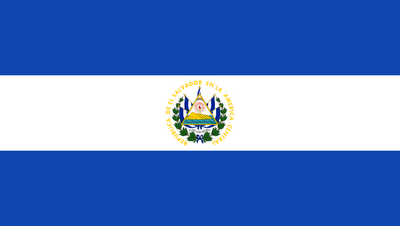 above: El Salvador's flag
In the country for a week (after attending business at Victoria - Transmission Global Summit 2012; flew from Vancouver - overnight at Fairmont Airport Hotel - on Continental Airlines via Houston). To join Cynthia doing some voluntary work (she, not me!) at Suchitoto, as part of a small team of Stratford Shakespeare Theatre people, helping out local theatre troop esArtes (see further blog entries)...
A country defined in our mind by the events of the last 20-30 years: violence – civil war (all of the 1980’s; a peace deal was put together in 1992, between the FMLN – Farabuno Marti National Liberation Front – and the right-wing, US-backed, military government); high homicide and gang fights afterwards; natural disasters (1998 – Hurricane Mitch, hundreds dead, thousands homeless; massive earthquakes in 2001 and 2005, etc.). And poverty – it goes along!
Violence, that a visitor will experience in history, but not in the reality of his or her stay (it is very safe, if you stay away from gang areas at night – which one wouldn’t go to anyway – and take some minimum precautions that apply to every situation when one is travelling!)
When one reads some of the history of the country, you can see where the violence is coming from: remnants of 3 centuries of Spanish colonialism (to 1821); followed by domination exercised by a few landowner families (owners of coffee plantations; coffee, replacing indigo as main export, used around 1900 to account for 95% of foreign exports); revolts from non-owner peasants (the”campesinos”), which were crushed (e.g. “La Matanza”, the peasant revolt in 1932; also the “Mozote Massacre” later on, at the beginning of the civil war in 1981). Political polarization as a result; civil war follows naturally. People movements: gangs expelled from US, re-incarnated in El Salvador. All that fuelled by continuing poverty and unequal distribution of wealth, between a well-to-do small minority, and the rest of the people…
 above: a map of El Salvador; its 14 departments
El Salvador has a somewhat special relation with the US, and not only because of the support the latter offered the military government during the civil war - $7B! The country went as far as seeking statehood in the US immediately after independence from Spain in 1821! Also it is said that roughly 2 million Salvadorans (or Salvadoreans – we could not get a firm judgment on the spelling!), the equivalent of a third of the country’s population, live illegally in the United States, sending some US$3.5B home in remittances, yearly, which would account for 15% of the country’s GDP!)Altogehter, more than the equivalent of half of the country's population still lives abroad...
A new era, with the current elected (2009) moderate president, Mauricio Funes, backed by the now legitimized FMLN.
This used to be the land of the Maya (along with the Yucatan and other Central American countries north of El Salvador). At the height of Maya civilization (right up to the 10th century AD), there was perhaps 10 million Maya, dispersed on that land, in various city-states (no centralized ruler, unlike the Incas in Peru). It all came crashing down around A.D. 900 for no explainable reason (except a variety of cited causes – famine, warfare, deforestation, fatal volcanic eruptions, etc.) We are left with ruins – the better known here in El Salvador is at Tazumal, in the west of the country – and a prophecy: the world as we know it will end this year on December 21!!! (However, see separate blog entry on that very topic!) above: a picture of Maya's ruins, at Tazumal. Photo license Creative Commons
Intriguing: there was an attempt at federalism between Central American countries (the Central American Federation) a couple of years after the liberation from Spanish colonialism in 1821, but it did not last: it was dissolved in 1838, victim of tensions, it would appear, between different ideologies (liberals and conservatives – a loose versus a centralized federation?), and strong centrifuge local powers and interests which eventually prevailed…
San Salvador, February 13, 2012

In the country for a week (after attending business at Victoria - Transmission Global Summit 2012; flew from Vancouver - overnight at Fairmont Airport Hotel - on Continental Airlines via Houston). To join Cynthia doing some voluntary work (she, not me!) at Suchitoto, as part of a small team of Stratford Shakespeare Theatre people, helping out local theatre troop esArtes (see further blog entries)...
A country defined in our mind by the events of the last 20-30 years: violence – civil war (all of the 1980’s; a peace deal was put together in 1992, between the FMLN – Farabuno Marti National Liberation Front – and the right-wing, US-backed, military government); high homicide and gang fights afterwards; natural disasters (1998 – Hurricane Mitch, hundreds dead, thousands homeless; massive earthquakes in 2001 and 2005, etc.). And poverty – it goes along!
Violence, that a visitor will experience in history, but not in the reality of his or her stay (it is very safe, if you stay away from gang areas at night – which one wouldn’t go to anyway – and take some minimum precautions that apply to every situation when one is travelling!)
When one reads some of the history of the country, you can see where the violence is coming from: remnants of 3 centuries of Spanish colonialism (to 1821); followed by domination exercised by a few landowner families (owners of coffee plantations; coffee, replacing indigo as main export, used around 1900 to account for 95% of foreign exports); revolts from non-owner peasants (the”campesinos”), which were crushed (e.g. “La Matanza”, the peasant revolt in 1932; also the “Mozote Massacre” later on, at the beginning of the civil war in 1981). Political polarization as a result; civil war follows naturally. People movements: gangs expelled from US, re-incarnated in El Salvador. All that fuelled by continuing poverty and unequal distribution of wealth, between a well-to-do small minority, and the rest of the people…

El Salvador has a somewhat special relation with the US, and not only because of the support the latter offered the military government during the civil war - $7B! The country went as far as seeking statehood in the US immediately after independence from Spain in 1821! Also it is said that roughly 2 million Salvadorans (or Salvadoreans – we could not get a firm judgment on the spelling!), the equivalent of a third of the country’s population, live illegally in the United States, sending some US$3.5B home in remittances, yearly, which would account for 15% of the country’s GDP!)Altogehter, more than the equivalent of half of the country's population still lives abroad...
A new era, with the current elected (2009) moderate president, Mauricio Funes, backed by the now legitimized FMLN.
This used to be the land of the Maya (along with the Yucatan and other Central American countries north of El Salvador). At the height of Maya civilization (right up to the 10th century AD), there was perhaps 10 million Maya, dispersed on that land, in various city-states (no centralized ruler, unlike the Incas in Peru). It all came crashing down around A.D. 900 for no explainable reason (except a variety of cited causes – famine, warfare, deforestation, fatal volcanic eruptions, etc.) We are left with ruins – the better known here in El Salvador is at Tazumal, in the west of the country – and a prophecy: the world as we know it will end this year on December 21!!! (However, see separate blog entry on that very topic!)

Intriguing: there was an attempt at federalism between Central American countries (the Central American Federation) a couple of years after the liberation from Spanish colonialism in 1821, but it did not last: it was dissolved in 1838, victim of tensions, it would appear, between different ideologies (liberals and conservatives – a loose versus a centralized federation?), and strong centrifuge local powers and interests which eventually prevailed…
San Salvador, February 13, 2012
dimanche 18 décembre 2011
Leonardo da Vinci…à Londres!
“Leonardo da Vinci: Painter at the Court of Milan”, au National Gallery de Londres
Un trou dans l’agenda d’affaires – prévu cependant puisqu’il fallait acheter un billet d’entrée chronométré, et au gros prix également : 8 fois le prix marqué, encore que le fournisseur, via le concierge de l’hôtel, en voulait d’abord 10 fois! Très courue, cette exposition, vantée comme la plus grosse de l’année à Londres!...

Voici comment les organisateurs de l’exposition la présentent: “Leonardo da Vinci: Painter at the Court of Milan’ is the most complete display of Leonardo’s rare surviving paintings ever held. This unprecedented exhibition – the first of its kind anywhere in the world – brings together sensational international loans never before seen in the UK. While numerous exhibitions have looked at Leonardo da Vinci as an inventor, scientist or draughtsman, this is the first to be dedicated to his aims and techniques as a painter. Inspired by the recently restored National Gallery painting, The Virgin of the Rocks, this exhibition focuses on Leonardo as an artist…”
Da Vinci a fait très peu de toiles, pas plus d’une vingtaine tout au cours de son existence, et encore, il ne les a pas toutes terminées! La plupart de ces toiles ont été peintes du temps où il était effectivement à Milan, d’environ 1482 à 1499, pour le compte de Ludovic Sforza, dit le Maure, comte de Milan, comme artiste salarié - je présume que çà réduisait considérablement la précarité associée autrement au métier! (La Joconde a été peinte à Florence, après le tournant du siècle, quelques années après son départ de Milan).
Je n’en ai compté que 5 ou 6 à l’exposition, des toiles, auxquelles il faut ajouter l’énorme murale de la Cène, reproduite grandeur nature quelque vingtaine d’années après que l’original fut peint; celui-ci se trouve, très endommagé –presque complètement délavé, dû à la technique non éprouvée qu’a utilisée Léonardo à l’époque –toujours sur le mur du réfectoire du couvent Santa Maria della Grazie, à Milan. Il aurait mis plus de 6 ans à compléter le tableau!
En fait, ce qui frappe à l’exposition, c’est le grand nombre de dessins qui sous-tendent chaque peinture (je dirais qu’ils constituent près de 80% à 90% des objets exposés)! Il faut voir par exemple le nombre de croquis qui ont inspiré chacun des 12 apôtres – sans parler du Christ lui-même –sur la Cène.
Peu de toiles, mais combien prenantes! Notamment ces visages de femme que sont les portraits respectifs de Cecilia Gallerani (la Dame à l’hermine), jeune maîtresse de Ludovic, à 16 ans. ( Voici comment un contributeur à Wikipédia commente l’œuvre : « Le tableau concentre toutes les innovations du portrait inspiré à Léonard: la pose de trois-quart, le visage tourné vers le spectateur, la grâce du geste de la main… « la définition de la forme par la lumière », et « le sens du mouvement interrompu7» (Cécilia semble tourner la tête comme si quelqu’un lui parlait)…Le décalage entre la richesse des vêtements, le geste ferme et le visage encore juvénile ajoutent au charme du tableau…. »)
Et celui de la Belle Ferronière(portrait de sa femme, dit-on, à en juger par son air plutôt soupçonneux!...ou qui sait, peut-être celui d’une autre maîtresse, rivale!) .
Sans parler des deux versions de la Vierge aux rochers, réunies dit-on pour la première fois, peintes à plus de quinze ans d’intervalle, dont l’une réside au Louvre, et l’autre en permanence à la National Gallery de Londres. Remarquable également ce dessin aux dimensions hors-normes, de la vierge assise sur les genoux de sa mère, Anne, avec le Christ enfant et St-Jean Baptiste. Presque sans couleur, mais combien vivant!
L’exposition est bondée – impressionnant de voir tous ces gens (la plupart d’un « certain âge » - ils ont le temps!) patiemment faire la queue devant chacun des dessins et peintures, autoguide à l’oreille et livret en main!... Elle se tient essentiellement dans l’aile Sainsbury, la plus moderne du musée, et se termine dans une salle (« Sunley Room ») au cœur de la National Gallery – ce qui vous permet de déambuler nonchalamment parmi les hauts faits de la peinture du XVe et du XVIe siècle de l’Europe – un véritable temple de la culture et de l’art que ce musée!…
Londres, le 12 décembre 2011
Un trou dans l’agenda d’affaires – prévu cependant puisqu’il fallait acheter un billet d’entrée chronométré, et au gros prix également : 8 fois le prix marqué, encore que le fournisseur, via le concierge de l’hôtel, en voulait d’abord 10 fois! Très courue, cette exposition, vantée comme la plus grosse de l’année à Londres!...

Voici comment les organisateurs de l’exposition la présentent: “Leonardo da Vinci: Painter at the Court of Milan’ is the most complete display of Leonardo’s rare surviving paintings ever held. This unprecedented exhibition – the first of its kind anywhere in the world – brings together sensational international loans never before seen in the UK. While numerous exhibitions have looked at Leonardo da Vinci as an inventor, scientist or draughtsman, this is the first to be dedicated to his aims and techniques as a painter. Inspired by the recently restored National Gallery painting, The Virgin of the Rocks, this exhibition focuses on Leonardo as an artist…”
Da Vinci a fait très peu de toiles, pas plus d’une vingtaine tout au cours de son existence, et encore, il ne les a pas toutes terminées! La plupart de ces toiles ont été peintes du temps où il était effectivement à Milan, d’environ 1482 à 1499, pour le compte de Ludovic Sforza, dit le Maure, comte de Milan, comme artiste salarié - je présume que çà réduisait considérablement la précarité associée autrement au métier! (La Joconde a été peinte à Florence, après le tournant du siècle, quelques années après son départ de Milan).
Je n’en ai compté que 5 ou 6 à l’exposition, des toiles, auxquelles il faut ajouter l’énorme murale de la Cène, reproduite grandeur nature quelque vingtaine d’années après que l’original fut peint; celui-ci se trouve, très endommagé –presque complètement délavé, dû à la technique non éprouvée qu’a utilisée Léonardo à l’époque –toujours sur le mur du réfectoire du couvent Santa Maria della Grazie, à Milan. Il aurait mis plus de 6 ans à compléter le tableau!
En fait, ce qui frappe à l’exposition, c’est le grand nombre de dessins qui sous-tendent chaque peinture (je dirais qu’ils constituent près de 80% à 90% des objets exposés)! Il faut voir par exemple le nombre de croquis qui ont inspiré chacun des 12 apôtres – sans parler du Christ lui-même –sur la Cène.
Peu de toiles, mais combien prenantes! Notamment ces visages de femme que sont les portraits respectifs de Cecilia Gallerani (la Dame à l’hermine), jeune maîtresse de Ludovic, à 16 ans.

Et celui de la Belle Ferronière(portrait de sa femme, dit-on, à en juger par son air plutôt soupçonneux!...ou qui sait, peut-être celui d’une autre maîtresse, rivale!) .

Sans parler des deux versions de la Vierge aux rochers, réunies dit-on pour la première fois, peintes à plus de quinze ans d’intervalle, dont l’une réside au Louvre, et l’autre en permanence à la National Gallery de Londres. Remarquable également ce dessin aux dimensions hors-normes, de la vierge assise sur les genoux de sa mère, Anne, avec le Christ enfant et St-Jean Baptiste. Presque sans couleur, mais combien vivant!
L’exposition est bondée – impressionnant de voir tous ces gens (la plupart d’un « certain âge » - ils ont le temps!) patiemment faire la queue devant chacun des dessins et peintures, autoguide à l’oreille et livret en main!... Elle se tient essentiellement dans l’aile Sainsbury, la plus moderne du musée, et se termine dans une salle (« Sunley Room ») au cœur de la National Gallery – ce qui vous permet de déambuler nonchalamment parmi les hauts faits de la peinture du XVe et du XVIe siècle de l’Europe – un véritable temple de la culture et de l’art que ce musée!…
Londres, le 12 décembre 2011
samedi 19 novembre 2011
"Maya - Secret of their Ancient World" - exhibition at the ROM
Preview of exhibition, uniquely for members of the Museum (they are doing well: lots of members!...)http://www.rom.on.ca/maya
Covers the Classic Period of the Maya civilisation (the first 8 or 10 centuries AD - or CE for Common Era, in the more politically correct (non denominational) way of the Museum...)
Focus on Palenque, the city, the temple, the palace, arts and science in general, followed by the inevitable gift shop - picked up a small guide to the exhibition - just what we need as we are getting ready to move again! But how could you not get something by which we will be reminded of our visit...besides, it is a rather interesting "plaquette"...
Very didactorial, these exhibitions... Museums are good at making culture and history more accessible and palatable to larger segments of the population - they may be decried by some as "pandering to the masses", but that is precisely what they are for. Anyway, I find them excellent for the busy and "diversely-interested" persons that we are...
All of that reminded me of my visit to some of the Maya sites near Cancun - Chichen Itza and Ek Balam 3 years ago (see blog dated Nov 2008)
Toronto, November 18, 2011
Covers the Classic Period of the Maya civilisation (the first 8 or 10 centuries AD - or CE for Common Era, in the more politically correct (non denominational) way of the Museum...)
Focus on Palenque, the city, the temple, the palace, arts and science in general, followed by the inevitable gift shop - picked up a small guide to the exhibition - just what we need as we are getting ready to move again! But how could you not get something by which we will be reminded of our visit...besides, it is a rather interesting "plaquette"...
Very didactorial, these exhibitions... Museums are good at making culture and history more accessible and palatable to larger segments of the population - they may be decried by some as "pandering to the masses", but that is precisely what they are for. Anyway, I find them excellent for the busy and "diversely-interested" persons that we are...
All of that reminded me of my visit to some of the Maya sites near Cancun - Chichen Itza and Ek Balam 3 years ago (see blog dated Nov 2008)
Toronto, November 18, 2011
S'abonner à :
Messages (Atom)